It’s 11:40 PM, and the only light in the kitchen is your phone. Fourteen browser tabs open, six daycare websites, one calendar app counting down to the date your leave ends. Nineteen days. Every site uses some version of the same three photos: kids finger-painting, a teacher reading in a circle, a sign-in sheet nobody actually photographs. Every site says safe. Every site says loving. None of them say how you’re supposed to tell the difference from a couch at midnight, before you’ve set foot in a single building. You close one tab. Another one loads behind it, same three photos, different logo.
Two words carry all the weight on these pages, and almost none of the pages explain them. Certified means something specific in Texas, and licensed means something else entirely, close enough on a webpage to blur into one word. You can check the difference in about four minutes, from that same couch, before you tour a single center.
What Makes a Daycare “Safe and Certified” in Texas?
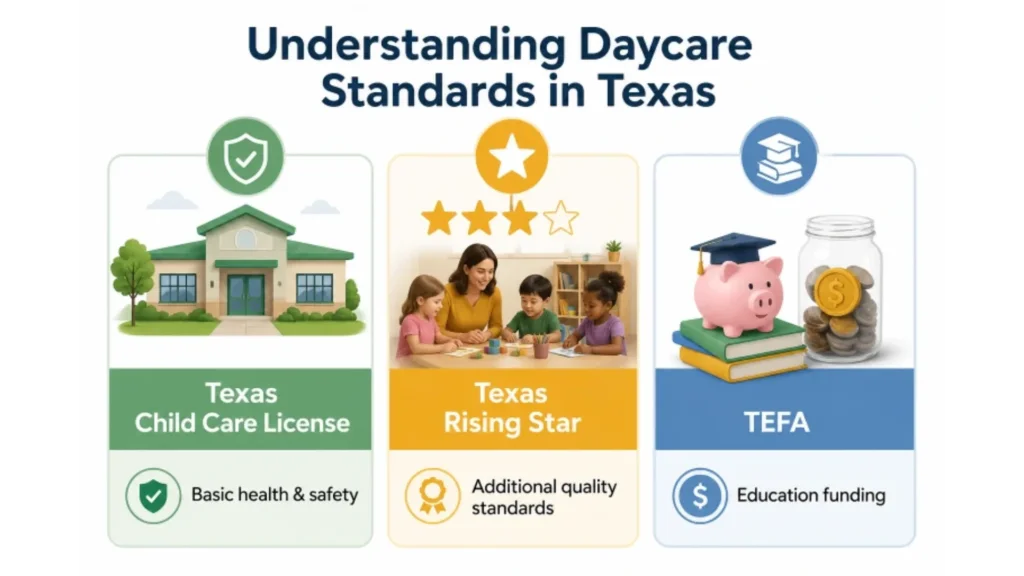
Every daycare that takes children in Texas needs a license. That’s the floor, not the ceiling everyone imagines. Texas Rising Star sits on top of that floor, a separate rating system that grades centers from two stars to four. A center can hold a license and never touch Rising Star. Earn Rising Star certification instead, and inspectors start checking things a basic license never asks about. TEFA is a third, different thing, a funding account, not a safety rating, and it changes your bill more than it changes your safety checklist. Ask a director which one they actually hold and watch how fast the real answer comes. That speed tells you more than the tour will.
Curious what this looks like in practice? See our current age groups and openings.
Licensed, Rising Star Certified, or Accredited: What Each Label Actually Means
A license comes from the state and covers the basics: staff background checks, fire code, minimum space per child, the numbers that keep a center legally open. Texas Rising Star adds a second layer on top: an optional rating a center chooses to pursue, and a completely different reviewer checks it than the one who does licensing inspections. Accreditation is a third, private layer. An outside organization runs it, not the state, and very few Texas centers carry one at all. Marketing pages rarely spell out which of the three a center actually holds, since all three sound reassuring enough to leave vague.
How Do You Check a Daycare’s License and Violation History Yourself?
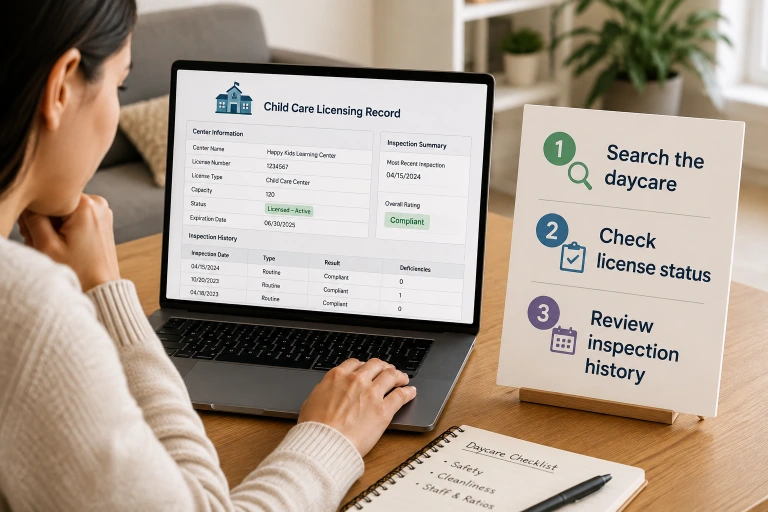
Search Texas Child Care is the state’s public tool for exactly this, free, no login required. Type in a center’s name, or just the city, and a list comes up with the license number attached to each result. Click through, and you get license status, the date of the most recent inspection, and every deficiency on file going back years, not months. Most parents never open it. The ones who do usually find nothing alarming, a routine inspection here, a minor paperwork note there, and that’s actually the point. A clean, unremarkable record is what you’re hoping for.
A record with repeated deficiencies in the same category, especially anything under supervision or ratios, deserves a direct conversation with the director before you book a tour, not after. Ask what happened and how it changed. A director who answers specifically did the work. One who gets defensive or vague just told you something, too.
Run this search before you call anyone. It takes about four minutes and changes what you notice on the actual tour. You stop looking at the paint and start looking at the staff.
The Staffing Ratios and Qualifications That Actually Matter
Texas sets the infant ratio at four babies to one adult, the tightest number on the books and the one that matters most if you’re hiring before your child turns one. That ratio loosens as kids get older: more children are allowed per adult in the toddler room, and more again by preschool, because older kids need less constant physical attention and more structured activity.
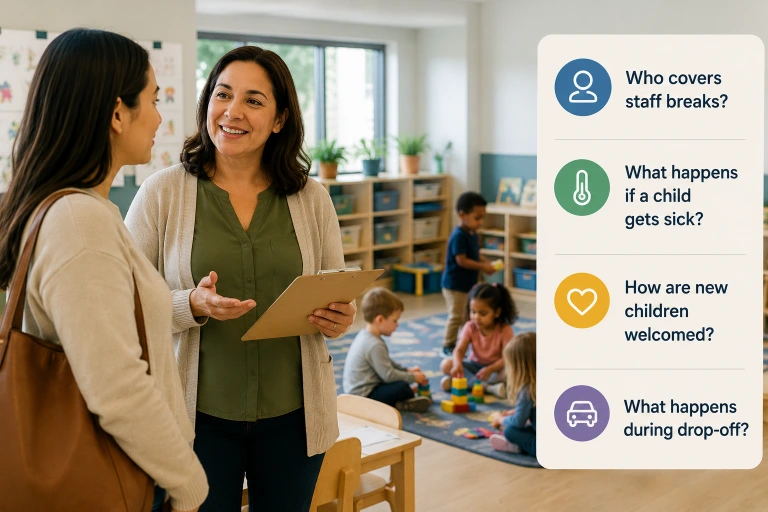
The number on paper only means something if the center actually holds it on a Tuesday afternoon in October, not just during a scheduled inspection. Ask how ratios get covered during breaks, lunch, and the last hour before closing, the times centers are most likely to run thin. A director who has a specific answer, a name for who covers what, runs this well. A shrug means find out the hard way later.
Turnover matters just as much as the ratio itself. A caregiver who has been in the same room for two years knows your child’s sleep cues and food preferences before you say a word. A revolving door of new faces every few months means nobody holds that knowledge, no matter how good the ratio looks on paper. Every adult working in a Texas child care center clears a background check before they’re allowed near your kid, no exceptions written into the rule. That’s the baseline everyone clears. How long the person who passed it decides to stay says more about the center than the check itself ever will.
What Should You Ask During a Daycare Tour?
A tour tells you two different things at once: what the director says and what the room shows you, and they don’t always match. The questions matter less than whether the answers come fast or get workshopped in real time. Every tour has a script, a route through the building that shows the best room first and saves the infant hallway for last, if they show it at all. Ask to see it anyway. Watch the kids while the director talks, not the director. A room full of engaged, occupied children tells you more than a scripted answer about curriculum ever will.
Questions Worth Asking
Ask what happens when a child gets sick mid-day, not the general illness policy, the actual mid-day version. Ask who covers a classroom when the regular teacher calls out. Ask how a new child’s first week usually goes, specifically, not in general terms. Ask what the center does differently for a child who’s struggling to separate at drop-off after week two, not week one, when the honeymoon period usually ends. A director who has run this exact tour fifty times has fifty real answers ready. One who’s improvising sounds like it.
What to Watch While You’re There
Watch how a caregiver responds when a toddler cries during your visit, not after you leave, right in front of you. Notice whether the room smells like nap time or like someone sprayed bleach five minutes before you walked in. Count how many adults are actually present against how many kids are in the room, and compare that number to what you looked up before you came. A quiet room isn’t automatically a calm one. Sometimes it means the kids have learned that staying quiet earns a reward.
Daycare Red Flags: What to Walk Away From vs. What to Ask About
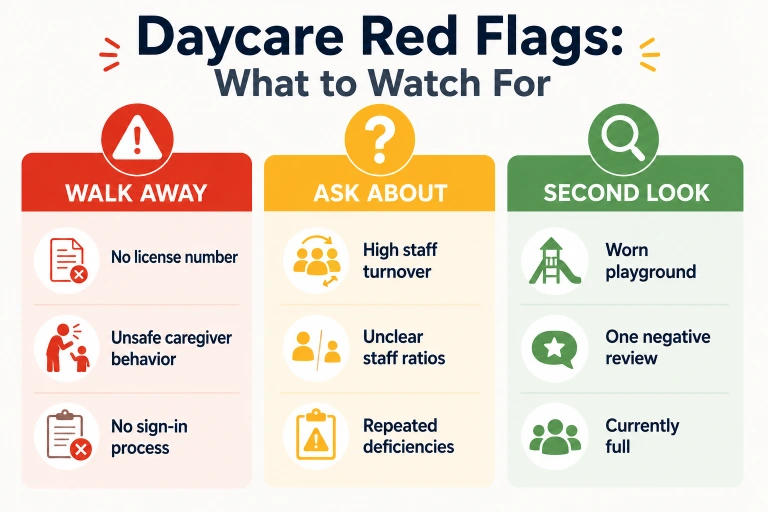
Some problems end the conversation immediately. Most don’t, and treating every imperfect answer like a dealbreaker leaves you searching forever. The difference is worth knowing before you’re standing in a lobby with a toddler on your hip and a decision to make. Pulling the record from the state’s search tool turns a gut feeling into something closer to evidence, which is the whole point of checking it first.
Walk Away
No license number, or one that doesn’t match the state’s record. A locked door with no sign-in process at all. A caregiver who raises their voice at a crying toddler while you’re standing right there. A staff member who won’t tell you their own name when you ask. These aren’t judgment calls. They’re the moment you say thank you and leave.
Ask Before You Decide
High staff turnover, especially in the infant and toddler rooms where consistency matters most. A director who can’t or won’t give a straight ratio number for your child’s age group. Kids who seem flat, not upset exactly, just unengaged, staring more than playing. More than one deficiency in the same category on the state record within the past year. Any of these deserves a direct follow-up question, not an automatic no.
Worth a Second Look, Not a Dealbreaker
A slightly worn playground. A director running fifteen minutes late because a parent showed up in crisis. One negative review sitting next to forty good ones. A center that’s fully booked and can’t take a tour for three weeks. That’s often a sign good centers stay full, not a warning sign at all. None of these predict how your child’s actual day will go, and treating them like red flags means ruling out centers that would have worked fine.
CTA: Compare us against this checklist. Schedule a tour and see for yourself.
Is Daycare Affordable in Alief and Sugar Land? What TEFA Changes
Full-time care costs more than most first paychecks account for, and nobody budgets for it accurately until they’re three weeks into actually paying it. Prices vary center to center and change year to year, so treat any number you read online, including this one, as a starting point for a phone call, not a final answer.
Ask for the current rate sheet directly rather than trusting what’s posted anywhere, including a center’s own website. Rates shift, enrollment periods change, and a sibling discount or a full-time versus part-time schedule can move the number more than people expect. Ask about registration fees and deposit policies too- the costs that don’t show up on the weekly rate but show up on the first bill anyway. A waitlist deposit that’s non-refundable if you change your mind is common enough that it’s worth asking about before you commit to one, not after.
What TEFA Actually Changes
TEFA, the Texas Education Freedom Account, is a state-funded account parents can put toward eligible education expenses, and it’s newer than most parents realize, which is exactly why almost nobody has explained it clearly yet. The amount depends on household income and the state’s yearly rules, not a flat number every family gets. What matters for a daycare search specifically is simpler: ask a center directly whether they’re approved to accept it, because approval isn’t universal, and a center that says yes should be able to walk you through what that actually looks like on your bill.
Texas Workforce Commission child care scholarships are a separate program from TEFA. They’re income-based, and local workforce boards run them instead of the state comptroller’s office. Families juggling both should ask a center which programs they actually accept, since not every center accepts every funding source.
Daycare, In-Home Care, or a Nanny: Which One Fits Your Family
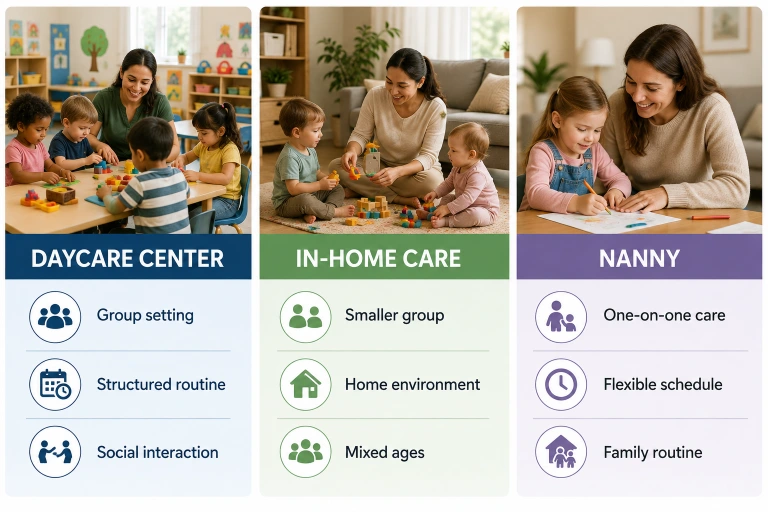
Three real options exist, and most parents only seriously research one of them before deciding. Each one trades something for something else. None of them is universally better, whatever the comparison articles imply. The right one depends on what your family actually needs on a Tuesday morning, not what sounds best in theory.
Daycare Center
More structure, more oversight, more adults watching each other work, which naturally limits what any one bad actor could get away with unnoticed. Your child socializes with a group their own age every single day. The tradeoff is less individual attention per child and a set schedule that doesn’t bend for a late morning.
In-Home Care
Smaller group, often a handful of kids across mixed ages. A licensed provider runs it out of their own home. Some families prefer the sibling-like dynamic and the flexibility that comes with a smaller operation. The tradeoff is less built-in oversight, since there’s no second adult watching the first one the way a center structure provides.
A Nanny
One adult, one-on-one attention, a schedule built entirely around your family’s hours. No licensing requirement exists for a nanny in Texas the way it does for a center or a registered home, so the vetting responsibility sits entirely with you, the background check, the references, all of it. That’s not a flaw in the option itself, just a different kind of work upfront, the kind a center or a licensed home does for you as part of what you’re paying for.
Does Care Look Different for Infants, Toddlers, and Preschoolers?
Yes, and not just in the obvious ways. What a center actually does changes shape at each stage, not just the toys on the shelf. Infants need physical care first, structure second. Preschoolers need it flipped, structure first, physical care handled quietly in the background.
Infants
Sleep is the whole job at this stage, more than people expect when they walk in. Ask specifically how the room handles safe sleep positioning, since Texas rules are strict here and a center that fumbles the answer is fumbling the thing that matters most for a baby under twelve months. A crib check every fifteen to twenty minutes is the standard, not something extra a center is doing you a favor by mentioning. Feeding schedules should match what you’re already doing at home, not force a switch on week one. Our infant care program covers six weeks through twelve months with that ratio and routine built around exactly this.
Toddlers
Separation anxiety peaks somewhere in here, usually worse at drop-off in week three than week one, which surprises parents who expected the opposite curve. Ask how the center handles a toddler who bites, specifically, because it happens at every single toddler program eventually, and how a director answers that question without flinching tells you whether they’ve actually managed it before. A good toddler room has a real routine, not just supervised free time, and potty training support that follows your pace rather than the center’s calendar. Our toddler program picks up right where infant care leaves off, same building, familiar faces.
Preschoolers and Pre-K
This is where curriculum starts to matter in a way it didn’t before, early literacy, number sense, the first real structure that resembles a classroom. A day that’s all worksheets is overcorrecting just as much as a day that’s all free play. The best rooms mix both, breaking up structured learning blocks with the kind of unstructured play that actually cements new skills instead of just introducing them. Ask what a typical day actually looks like hour by hour, not the mission-statement version. Our preschool program and Pre-K program build toward kindergarten readiness specifically, with the difference between the two coming down mostly to age and what a day looks like structurally.
Finding the Right Fit in Alief and Sugar Land
The checklist doesn’t change depending on which center you’re evaluating, here or anywhere else in Texas. What changes is what’s actually available nearby, and how far you’re willing to drive at 6:45 in the morning with a toddler still half asleep in the car seat. A center fifteen minutes from home stops feeling convenient by the third week of a 6 AM alarm, no matter how good the reviews are.
Fairland Learning Academy sits on Synott Rd, inside Harris County, close enough to both Alief and Sugar Land that families from either side end up on the same tour schedule. It holds a Texas Rising Star 3-Star certification, the higher tier past a basic license. It’s also TEFA-approved, with a direct answer ready for exactly what that means on a specific bill, not a general one.
Programs run from six weeks through twelve years, infant through after-school care and summer camp, with hours that run 6:30 AM to 7:00 PM, early enough for a typical commute, late enough that a late meeting doesn’t turn into a scramble. Drop-off runs the way most working parents actually need it to, not a rigid ten-minute window that punishes a bad traffic day on the way in. See our approach before you decide anything.