
You’re standing at pickup, half-listening to another parent talk about how her son already writes his own name. Yours still calls it “big scribble.” She’s not bragging. She’s just talking. But you drive home running the numbers in your head.
Kindergarten starts in the fall. Is he ready? Are you behind? Did you miss something everyone else already knows?
If that sounds familiar, you’re not alone, and you’re not behind. Most parents start asking this question around now, which is exactly the right time to start looking for answers instead of just worrying about them.
This guide walks through what kindergarten readiness actually means, what a solid pre-K for kindergarten readiness in Alief, TX looks like day-to-day, and how a program like Fairland Learning Academy on Synott Rd builds those skills before your child ever sets foot in a kindergarten classroom.
Quick Answer: How Pre-K Builds Kindergarten Readiness
Kindergarten readiness is not one skill. It’s a mix of academic basics like letters and numbers, plus social skills like sharing and following directions, plus the ability to sit, focus, and separate from a caregiver without falling apart. A structured pre-k program builds all three at once, through daily routine, hands-on activities, and small-group practice, rather than leaving a child to pick it up on the first day of kindergarten.
The short version: readiness is built, not born. A good pre-k program gives your child repeated practice at exactly the moments kindergarten will demand.
What Does “Kindergarten Readiness” Actually Mean?
Kindergarten readiness means your child can handle the academic, social, and physical demands of a full kindergarten day, not that they already know everything a kindergartner will learn.
It’s easy to picture readiness as a checklist of academic facts. Can she count to 20? Does he know his letters? Those matter, but they’re only part of it.
Kindergarten teachers will also tell you readiness includes things that have nothing to do with academics at all. Can your child follow a two-step direction without you repeating it three times? Can they wait their turn in a group of 20 kids instead of one or two siblings? Can they separate from you at drop-off without a meltdown that eats up the first twenty minutes of the day?
This is why kindergarten readiness and pure academic knowledge are not the same thing. A child who knows every letter but cannot sit through circle time is going to struggle just as much as a child who’s behind on letters but comfortable in a classroom. The strongest pre-k programs build both sides at once, not just one.
The Kindergarten Readiness Checklist Every Alief Parent Should Know
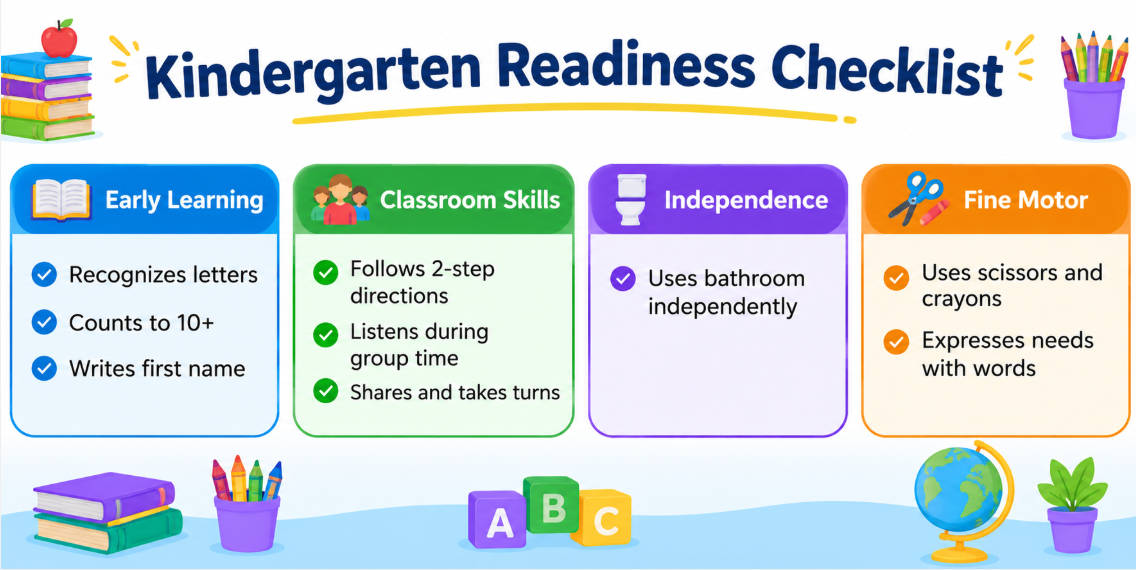
Here’s a practical, no-fluff checklist. Most kindergarten teachers would recognize every item on it. Your child doesn’t need to master all of it perfectly. Think of this as a general direction, not a pass/fail test.
- Writes or attempts to write their first name
- Recognizes most letters of the alphabet, both uppercase and lowercase
- Counts to 10 or higher, and understands that numbers represent quantities
- Uses scissors, crayons, and glue with reasonable control
- Follows a two-step direction, like “put your cup in the sink and grab your shoes”
- Sits and listens during a short group activity, like a story or circle time
- Separates from a parent or caregiver without prolonged distress
- Uses the bathroom independently
- Shares materials and takes turns during group play
- Expresses needs and feelings with words, not just crying or pointing
If your child is missing a few of these, that’s normal, not alarming. This is exactly what a pre-k year is for. Nobody expects a four-year-old to arrive at pre-k already checking every box. They’re expected to leave pre-k that way.
How Fairland’s Pre-K Program Builds These Skills
Fairland builds these readiness skills through daily structure, not a single big lesson. Every day follows a predictable rhythm of group learning, hands-on activities, and guided play, so children practice readiness skills over and over, in small doses, until they stick.
Fairland’s Pre-K Program follows the Frog Street Curriculum, a structured early-learning framework built around a few core areas: language and literacy, early math and STEM thinking, social and emotional learning, physical development, and creative arts. In plain terms, that means your child isn’t just doing worksheets. They’re building vocabulary through daily conversation and storytelling, practicing early counting and patterns through hands-on activities, and learning to manage feelings and build friendships as part of the regular school day, not as an afterthought.
Structure matters here more than people expect. A classroom with a low child-to-staff ratio means a teacher can actually notice when a child needs a nudge toward independence, or a little more practice with scissors, or extra encouragement during group time. That kind of individual attention is hard to replicate at home, simply because one adult can’t be four different teachers at once.
The daily routine itself is part of the lesson. Predictable schedules, the kind Fairland uses every day, teach children what circle time, transitions, and group instructions feel like, well before kindergarten makes those things mandatory.
Is My Child Behind for Kindergarten?
Probably not, and “behind” usually isn’t the right way to think about it. Kids develop these skills at different speeds, and a few weak spots at four years old are common, not a red flag.
It’s worth separating two very different situations. One is a child who is a little slower to warm up socially, or still working on scissors, or shy about writing their name. That’s just normal variation. Every kindergarten teacher sees a wide range of skill levels walk through the door in August, and a strong classroom is built to handle that range.
The other situation is a child with a specific, ongoing concern, like a speech delay or a diagnosed developmental difference. That’s a conversation for a pediatrician or an early childhood specialist, not something a checklist article can sort out.
For most families, the honest answer is that a structured pre-k year is exactly the tool designed to close small gaps. That’s its job. You don’t need your child to already be ready. You need a year that gets them there.
Fairland Pre-K, Public Pre-K, or Staying Home: Which Fits Your Family?
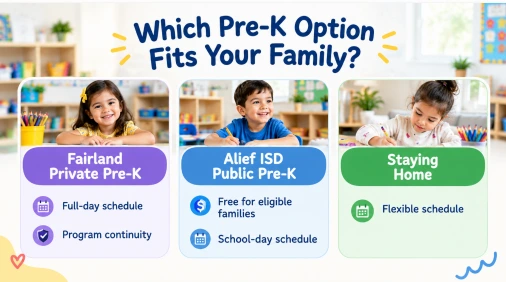
There’s no single right answer here. Fairland’s private pre-K, Alief ISD’s free public pre-K, and staying home another year all work for different families, depending on your schedule, budget, and what your child needs most.
This is usually where parents start feeling stuck. You’ve heard “free public pre-k” mentioned somewhere, you’re comparing it to a private option like Fairland, and you’re wondering if staying home one more year would just be simpler and cheaper. All three are reasonable choices. Here’s an honest look at each.
Public pre-K through Alief ISD is free for eligible families, which is a real advantage. It follows the district’s academic calendar, which means shorter days and a schedule built around a school year, not a working parent’s full day. It’s a solid option if you have flexible childcare coverage for the hours before and after school, and if your child doesn’t need infant, toddler, or after-school continuity through the same provider.
Fairland’s private pre-k runs on a full working day schedule, generally covering the hours a working parent actually needs, not just a few academic hours. It also means your child stays in one consistent environment, often with the same teachers and classmates, from toddler years through pre-k and into after-school care. For many Alief families, that continuity matters as much as the curriculum itself.
Cost is the obvious question, and it’s a fair one. Fairland accepts Texas Education Freedom Accounts (TEFA), the state’s newer school choice program that helps eligible families put state funds toward private early education costs. That doesn’t make private pre-K automatically free, but it can meaningfully close the cost gap for families who qualify, which is worth checking into before ruling private pre-K out on price alone.
Staying home another year is also a legitimate choice, especially for a child who seems young for their age or a family not ready to commit to a full daycare schedule. The tradeoff is that your child misses out on the structured group practice, the daily routine, and the peer social time that a pre-k classroom provides. If you go this route, look for ways to recreate small pieces of that structure at home, like regular reading time, a predictable daily schedule, and playdates that give your child practice sharing and taking turns.
Fairland Private Pre-K | Alief ISD Public Pre-K | Staying Home | |
Cost | Tuition-based, TEFA accepted for eligible families | Free for eligible families | No program cost |
Hours | Full working day, Mon–Fri, 6:30 AM–7:00 PM | Standard school-day hours | Flexible, parent-managed |
Teacher ratio | Low child-to-staff ratio | Varies by district classroom size | 1:1 with parent/caregiver |
Continuity into school-age care | Continues into after-school program at Fairland | Requires separate before/after care | Requires separate arrangement |
Best fit if… | You need full-day coverage and program continuity | You have flexible before/after school coverage | Your child needs another year before group settings |
None of these is the “correct” choice in the abstract. It depends on your work schedule, your child’s temperament, and what kind of support you need day to day.
What Age Should My Child Start Pre-K?
Most children start pre-K around age four, the year before kindergarten. Fairland’s Pre-K Program is built specifically for four-year-olds, which lines up directly with a standard kindergarten start the following fall.
There’s often confusion between “pre-k” as a general term and the specific ages it can cover. Some programs offer a “pre-k3” year for three-year-olds as an earlier, gentler introduction to a classroom setting, followed by a “pre-k4” year that’s more directly focused on kindergarten preparation. Fairland’s Pre-K Program is the Pre-K4 stage, designed for four-year-olds in the year immediately before kindergarten.
If your child is younger than four, that’s not a problem. Fairland’s Preschool Program covers ages two to three, which gives your child a full year or two of classroom experience before moving into the pre-k4 year. Starting a year early isn’t required, but it does mean your child walks into pre-k already comfortable with a classroom routine, which makes that final readiness year even more effective.
Timing your search matters too. Pre-K programs, especially ones with a strong reputation, tend to fill up. If your child will be four by the start of the school year, it’s worth starting the enrollment conversation months ahead rather than waiting until late summer.
From Pre-K to Elementary: How Fairland Connects to Schools
Fairland doesn’t just prepare your child for kindergarten in general. It offers direct school pick-up and drop-off service to several real elementary schools in the Alief and Houston area, which makes the transition from pre-K into kindergarten logistically easier, not just academically easier.
This is one of the more practical, and most overlooked, parts of choosing a pre-k program. It’s not just about what your child learns. It’s about how your daily routine will actually work once they’re enrolled in elementary school.
Fairland currently provides pick-up and drop-off service for children attending Heflin Elementary School, KIPP Unity Program, SST Avancement, Jefferson Early Learning Center, Mahanay Elementary School, Outley Elementary School, Leistman Elementary School, and Harmony School of Excellence. If your family is zoned to one of these schools, or already has an older child attending one, Fairland can fold directly into your existing school-day logistics rather than adding a second pickup location to manage.
This matters more than it might seem at first. A lot of the stress around starting kindergarten isn’t academic at all. It’s logistical: who’s picking up, from where, and what happens in the gap between school dismissal and the end of a workday. A pre-K program that already connects to your child’s future elementary school removes one more moving piece from that transition.
What Makes Fairland’s Pre-K Program Trustworthy?
Trust in a pre-k program usually comes down to two things: who’s checking that it’s actually safe and well-run, and how long it’s been doing this well. Fairland has verifiable answers to both.
Fairland Learning Academy is a Texas Rising Star 3-Star Certified childcare provider. In plain terms, Texas Rising Star is the state’s own quality rating system for childcare programs. It’s not a marketing badge a center gives itself. It comes from an outside review of things like teacher qualifications, classroom safety, and program quality, and centers earn a star rating based on how well they meet those standards. A 3-star rating means Fairland has been independently reviewed and meets a higher tier of those requirements, not just the minimum needed to stay open.
Fairland is also licensed through the Texas Health and Human Services Commission (HHSC), the state agency responsible for licensing and inspecting childcare facilities in Texas. Licensing is the baseline requirement to legally operate. Rising Star certification is the layer on top of that, showing the program has gone further than the minimum.
Beyond the paperwork, there’s simple longevity. Fairland has served Alief families since 2010, which means over fifteen years of daily experience with exactly the age group this article is about. A program that’s been doing this for over a decade has seen a lot of four-year-olds walk in nervous and walk out ready. That kind of track record is hard to fake and easy to verify.
If you want to see any of this for yourself, the most direct way is to visit. Come see a classroom for yourself and schedule a free tour.
Give Your Child a Confident Start
Readiness isn’t something a child either has or doesn’t have on some fixed timeline. It’s built, day by day, through practice, routine, and a classroom that gives your child real chances to try, stumble, and improve before kindergarten ever starts.
Wherever your child is right now, whether they’re already writing their name or still figuring out scissors, a structured pre-k year is exactly the tool designed to close that gap. That’s not a guess. It’s what pre-k is built to do.
If you’re ready to see what that looks like in person, reserve your child’s spot at Fairland today.