Does Summer Camp Actually Prevent Learning Loss?
People cite summer learning loss research constantly and rarely explain it clearly. The general finding, which multiple studies have repeated over the last couple of decades, holds that kids lose some ground academically over an unstructured summer, math skills especially, and the loss compounds year over year if nothing interrupts it. The exact numbers move depending on which study and which grade level you’re looking at, but the direction stays consistent enough that researchers at places like NWEA have built entire ongoing research programs around it. That’s worth knowing before anyone quotes you a specific percentage as though it’s an exact, universal number, because it isn’t.
What almost nobody explains is that the research measures structure, not subject matter. A kid doing hands-on science experiments, reading for a book club, practicing math through games, or building something with their hands gets cognitive engagement that counts, even without a worksheet in sight. The research doesn’t say unstructured time is fine as long as somebody labels it school. It says unstructured time itself is the variable that matters.
A camp that fills a day with genuine activity, reading time, problem-solving games, actual physical challenge, does more to interrupt that pattern than a completely open, unscheduled summer would. It’s not doing the same thing a remedial math class does for a kid who’s genuinely behind on a specific skill. Those are different jobs, and conflating them is where most of the guilt in this decision actually comes from. A parent who picked camp over a formal academic program didn’t skip the assignment. They picked a different, still legitimate way to keep a kid’s brain working through June, July, and August.

Why Summer School Doesn’t Solve the Full-Day Problem
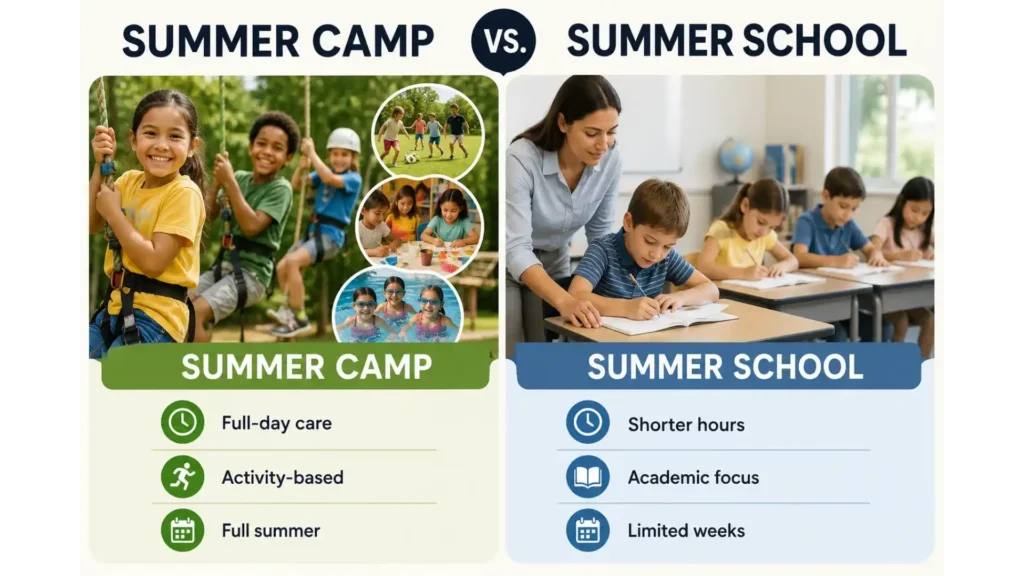
Nobody designed a program that ends at noon to solve a coverage problem, because coverage was never the goal. Most district summer school exists to close a specific academic gap for a specific group of kids, running a few weeks, a few hours a day, sometimes only a few days a week depending on the district. That’s a reasonable design for what it’s actually trying to do. It’s a bad fit for what a lot of parents are actually trying to solve.
Eligibility adds another layer most comparison articles skip entirely. A district program that centers on remediation typically isn’t open enrollment. A teacher recommendation, a test score, a specific gap the school identifies at the end of the year usually decides who gets a seat, not a parent’s calendar or a parent’s need for coverage. A family without a flagged academic gap may not have access to a summer school seat at all, whatever their actual scheduling need looks like.
None of this is a criticism of summer school. A program built for remediation that also tried to run eleven hours a day for every enrolled kid regardless of need would stop being able to do its actual job well. The mismatch isn’t a flaw in either program. It’s a mismatch between what one specific tool does and what a completely different problem requires. Both programs can be excellent at their actual job and still be the wrong match for a specific family’s actual week.
Is It Normal to Feel Guilty Choosing Camp Over “Academic” Summer School?
Yes, and the guilt usually isn’t really about your kid. It’s about a version of parenting that treats anything labeled academic as automatically more responsible than anything labeled fun, even when the actual research doesn’t support that hierarchy at all. Kids absorb that hierarchy early, from report cards, from the way adults talk about “real” learning versus “just” play, and it doesn’t switch off just because summer arrived.
A kid running a science experiment at camp, solving a group challenge, reading during a quiet hour built into the day, is doing real cognitive work. It doesn’t look like a worksheet, so it doesn’t feel like it counts, and that gap between how something looks and what it actually does is where most of this guilt lives.
There’s also a quieter version of this guilt that has nothing to do with academics. It’s the feeling that choosing the option that solves your actual scheduling problem, instead of the one that sounds more virtuous on paper, makes you a less committed parent. It doesn’t. A parent who needs a program to run a full day because a full workday exists isn’t cutting a corner. They’re solving a real problem with a real solution. Picking the program that matches your actual week isn’t a smaller decision than picking the one with the most impressive curriculum on the flyer, just a more honest one, made with a clearer set of facts about what your family actually requires.
Common Myths About Summer Camp and Summer School
Three misconceptions come up constantly in this decision, and all three make the choice feel more binary than it actually is.
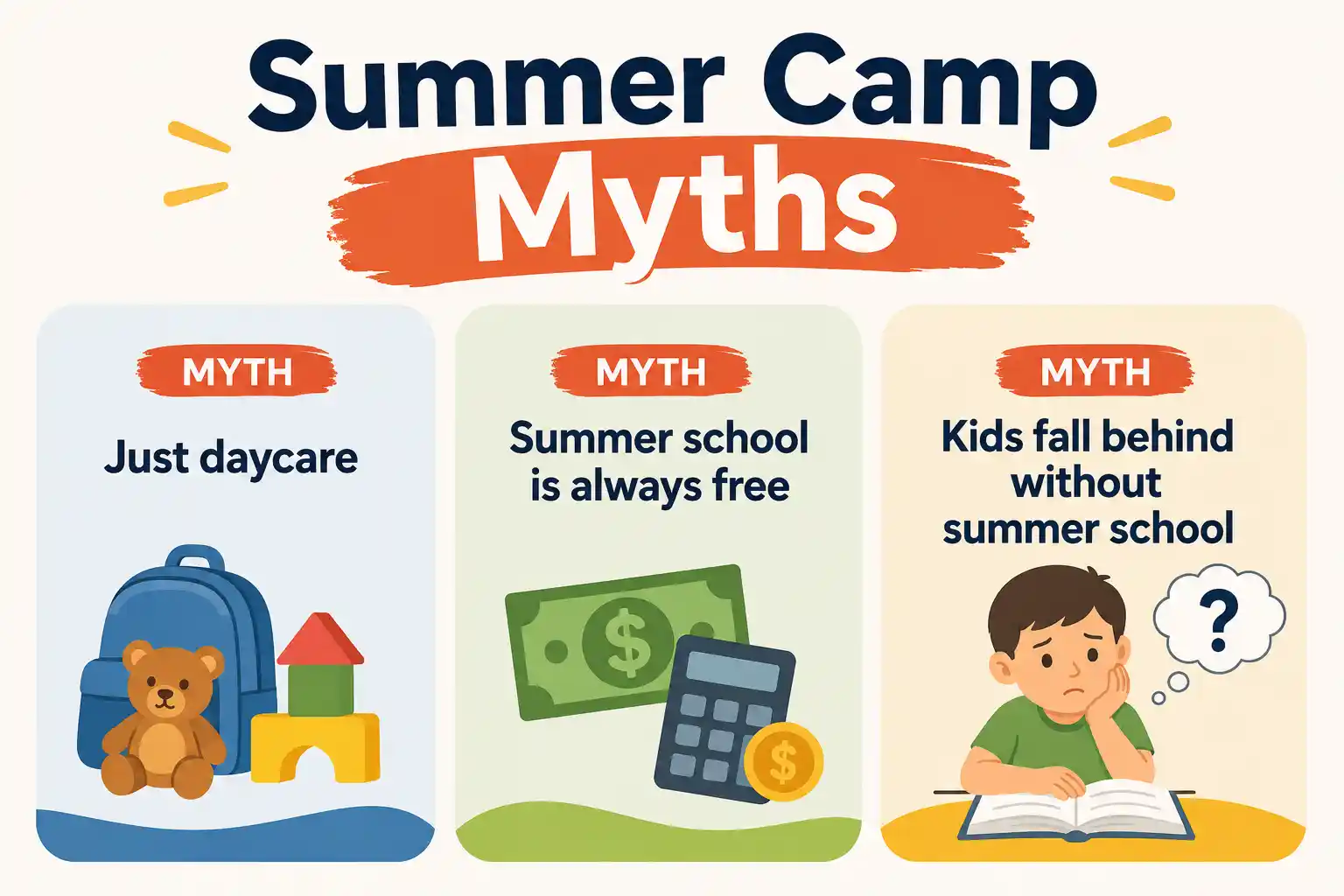
Camp is just daycare with extra crafts
A center running actual programming, science stations, reading blocks, structured group games, and real physical activity isn’t interchangeable with a room full of unsupervised free time. The difference shows up in what a kid is doing at 10 AM on a random Tuesday, not in the brochure language. A parent touring at 10 AM should be able to see the difference immediately, kids engaged in something specific, not just occupied.
Summer school is free and available to any kid who wants it
Some district programs are free, but free doesn’t mean open. Plenty of programs fill exclusively through teacher referral or a specific test-score threshold, and a family whose child doesn’t meet that bar may not have a seat available at any price, whatever the district’s website implies. Ask directly whether enrollment is open or eligibility-based before assuming a free program solves the coverage question for your family.
Kids Fall Behind Without Summer School
The learning-loss research points to unstructured time as the real variable, not the absence of a classroom specifically. A summer full of genuine activity and engagement, camp included, addresses the same underlying problem a lot of remediation-focused programs are built to solve, just through a different door. The classroom is one way to interrupt the pattern. It isn’t the only way, and treating it as the only legitimate one manufactures a lot of unnecessary guilt for no real reason.
Can You Do Both?
Some families do exactly this, and it works fine logistically in most districts. A child attends summer school for the required or recommended weeks, nine to noon, then transitions into a camp day for the remaining hours, picking up right where the morning left off.
The scheduling takes coordination, mostly around pickup and drop-off timing lining up between the two programs, but it isn’t unusual, and most camps are used to families arriving mid-morning on days like this. Most camps build in enough flexibility for exactly this kind of mid-morning arrival, since it’s common enough to plan around rather than treat as an exception. It solves both problems at once, the specific academic gap and the coverage gap, without forcing a parent to rank one need above the other.
This only makes sense for families whose child actually has a summer school obligation to begin with. For a family without one, adding a second program on top of camp solves a problem that was never really there, and turns a full, active summer into two half-days stitched together for no real benefit. Two programs aren’t automatically better than one good one just because they sound more thorough on paper.
Why Do Alief and Sugar Land Families Choose Camp?
Distance matters more in July than it does in October, when a hot car and a cranky kid make a fifteen-minute drive feel like forty. Families choosing between programs scattered across Houston often land on whichever one doesn’t add a second commute on top of an already long day. A camp fifteen minutes closer to home wins over a marginally flashier one an extra twenty minutes away more often than any brochure comparison would predict.
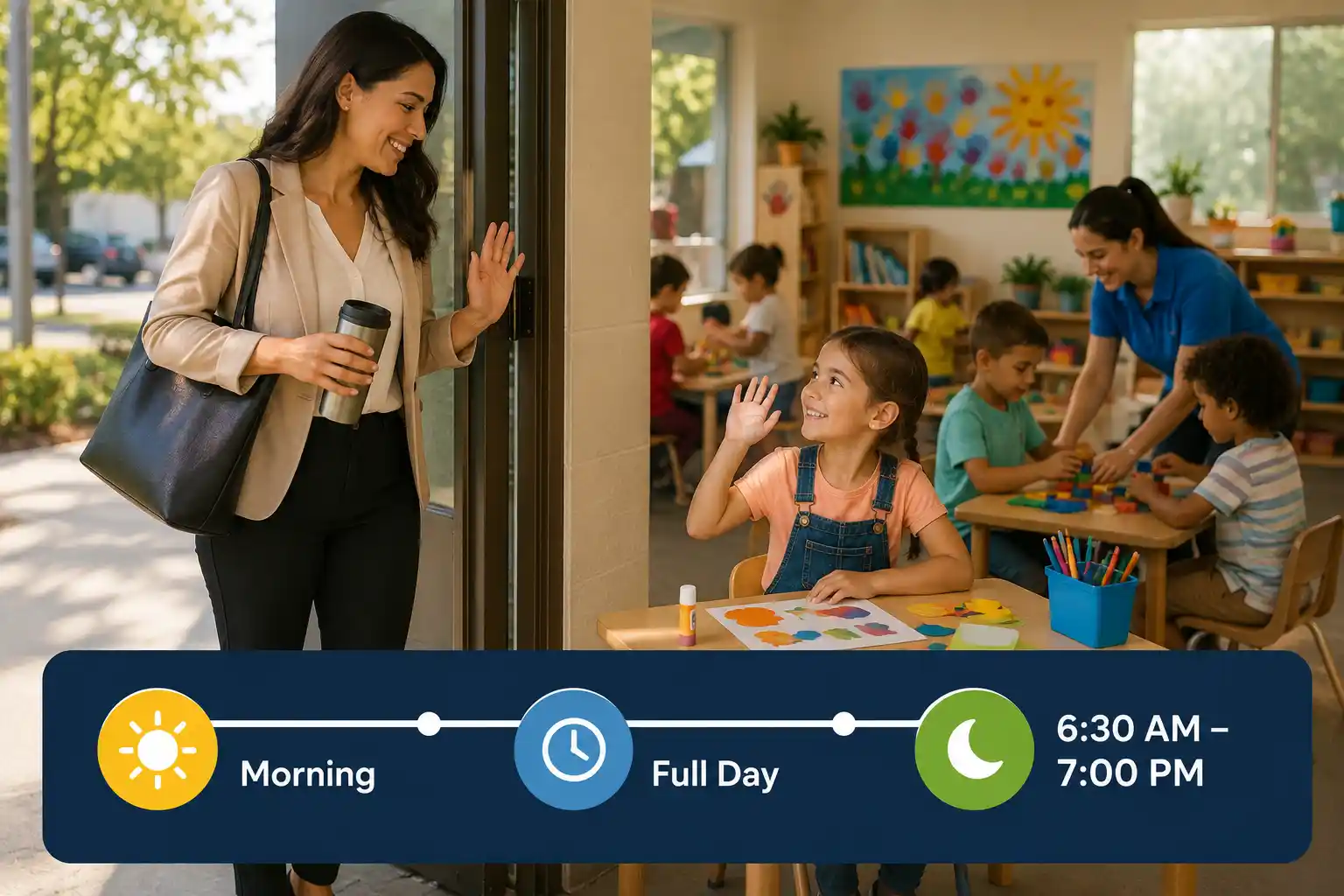
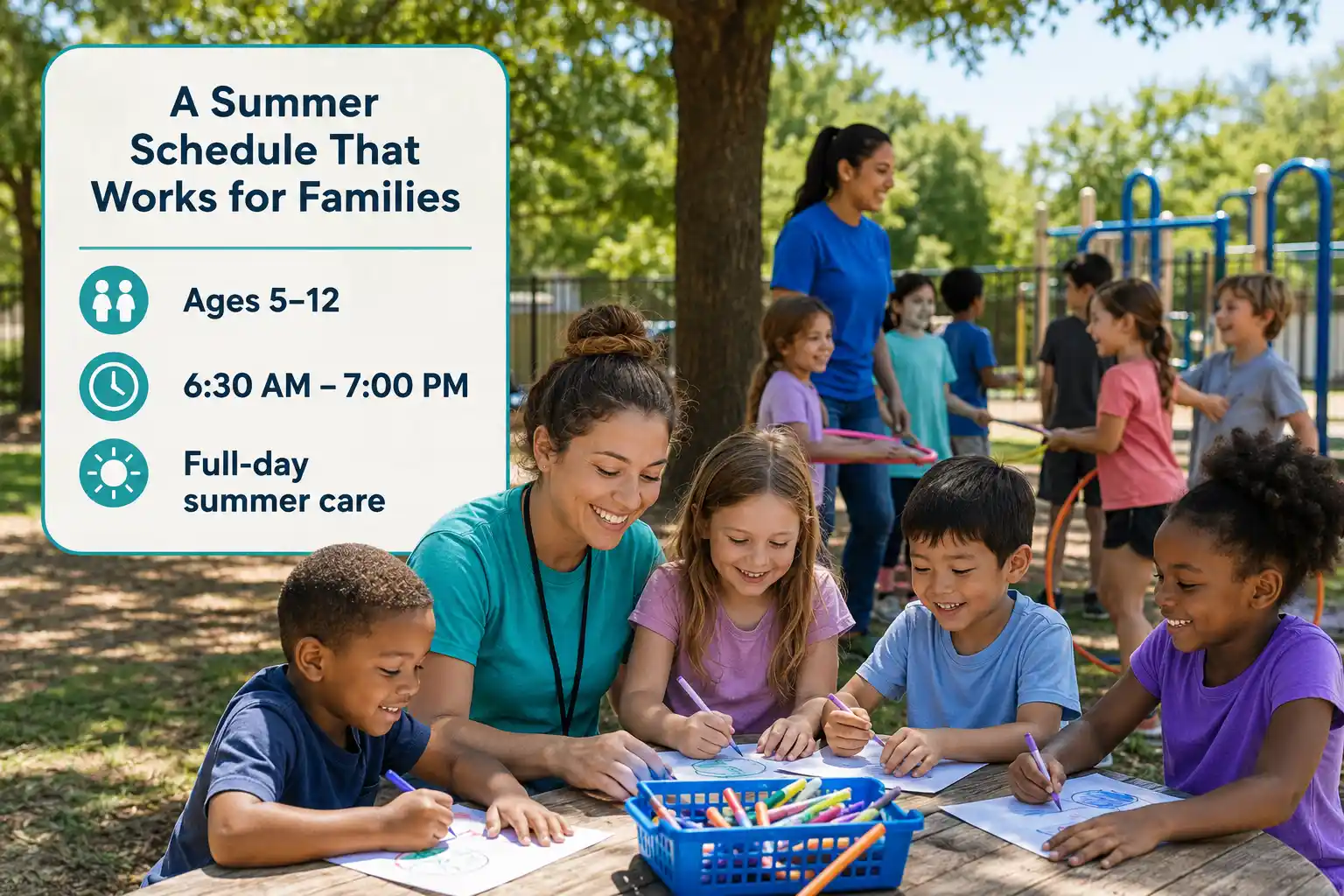
Fairland Learning Academy sits on Synott Rd, inside Harris County, close enough to both Alief and Sugar Land that pickup doesn’t become its own logistics project. Camp runs for ages five through twelve, the same hours as the rest of the year, 6:30 AM to 7:00 PM, so a family doesn’t have to juggle a shorter summer schedule on top of everything else that changes when school lets out. For families whose child is heading into the school year after camp, the transition into our after-school program is something new in September. That continuity is worth more to a lot of families than any single feature on a brochure, the same drop-off spot, the same pickup line, the same faces in October that were there in June.