It’s late, your child’s first day of daycare is coming up fast, and you’re sitting on the couch with your phone, typing “Frog Street curriculum” into Google. Maybe you just left a tour and heard the name for the first time. Maybe your leave is ending in three weeks and the guilt is louder than you’d like to admit. Either way, you want a straight answer to a simple question. Is this an actual teaching method, or is it just a word centers put on a brochure to sound impressive?
That question deserves a real answer, not a sales pitch. Here’s what the Frog Street curriculum actually is, and how Fairland Learning Academy uses it with children from six weeks old through Pre-K.
What Frog Street Means for Your Family
Frog Street curriculum is a published, research-informed early childhood program used by daycare and Pre-K centers across Texas, including Fairland Learning Academy in Alief. It gives teachers a structured, age-specific plan for building language, social skills, and early academics, instead of leaving each classroom to improvise its own approach.
At Fairland, that means your child’s learning is intentional at every stage, from an infant’s first sensory play to a Pre-K child’s kindergarten prep. It’s not a single lesson plan glued to the wall. It’s a framework that grows with your child.
Curious what this looks like in person? See our classrooms →
What Is the Frog Street Curriculum, Exactly?
Frog Street is a published early childhood curriculum, meaning it was built by early education specialists and sold to daycare centers, not written from scratch by any single center. It covers children from infancy through Pre-K, with a specific plan for each age group rather than one generic approach stretched across every classroom.
The idea behind it is simple. Instead of each teacher deciding what to cover week to week, the curriculum lays out consistent goals in language, movement, social skills, and early math and literacy, all matched to what children can actually handle at each age. Many daycares that use Frog Street curriculum choose it specifically because it removes the guesswork of building a program from zero.
That’s different from a center saying “we do circle time and free play” with no deeper plan behind it. A named curriculum gives you something concrete to ask about on a tour, which matters more than it might seem.
Is Frog Street Research-Based, or Just Another Marketing Word?
Yes, with real nuance worth knowing. Frog Street’s Pre-K materials have been reviewed by independent, non-affiliated education evaluators, not just praised by the company that sells them. Those reviews found genuine strengths in areas like literacy and social-emotional learning, alongside some areas rated as solid but not exceptional.
That’s actually a more trustworthy picture than a curriculum with only glowing self-reviews. No program is perfect at everything, and a center that tells you that honestly is more credible than one that claims otherwise. What matters most isn’t the curriculum on paper. It’s whether a center’s teachers are actually trained on it and using it every day, which is a question worth asking directly on any tour, at Fairland or anywhere else.
How Fairland Teaches Frog Street, Age by Age
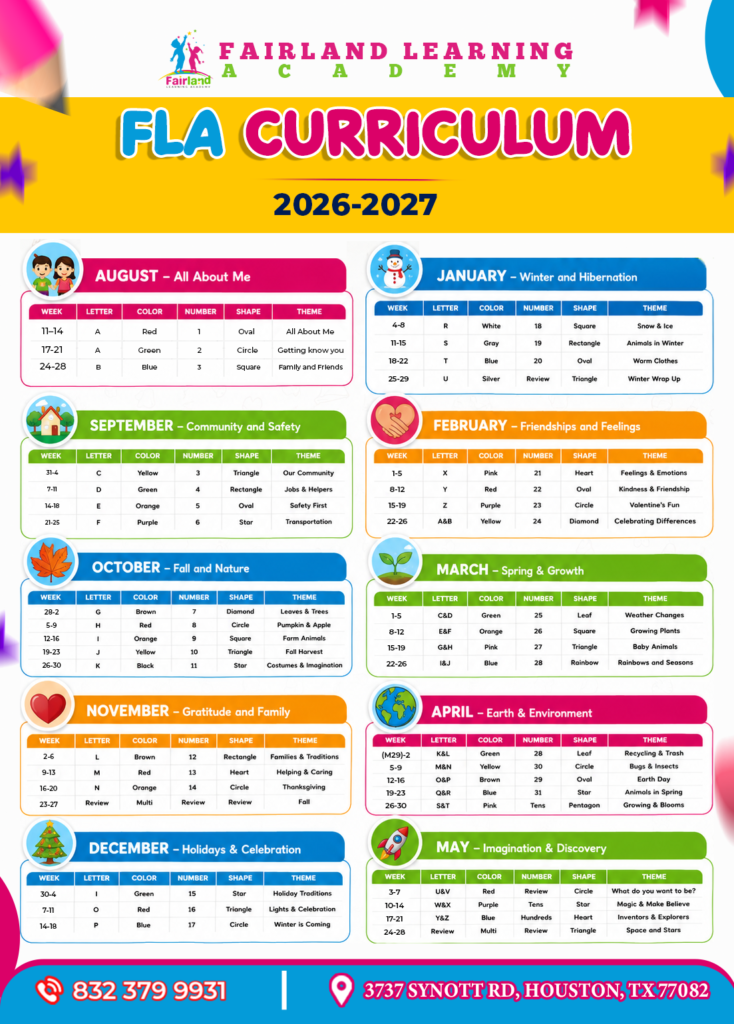
Fairland runs four connected stages under the Frog Street curriculum: Infant (6 weeks to 12 months), Toddler (13 to 24 months), Preschool (2 to 3 years), and Pre-K (4 years). Each stage builds on the one before it, so your child isn’t starting over in a new classroom. They’re continuing the same thread of learning, just with new skills layered on top.
Infant Program (6 Weeks–12 Months): Building Trust Through Routine
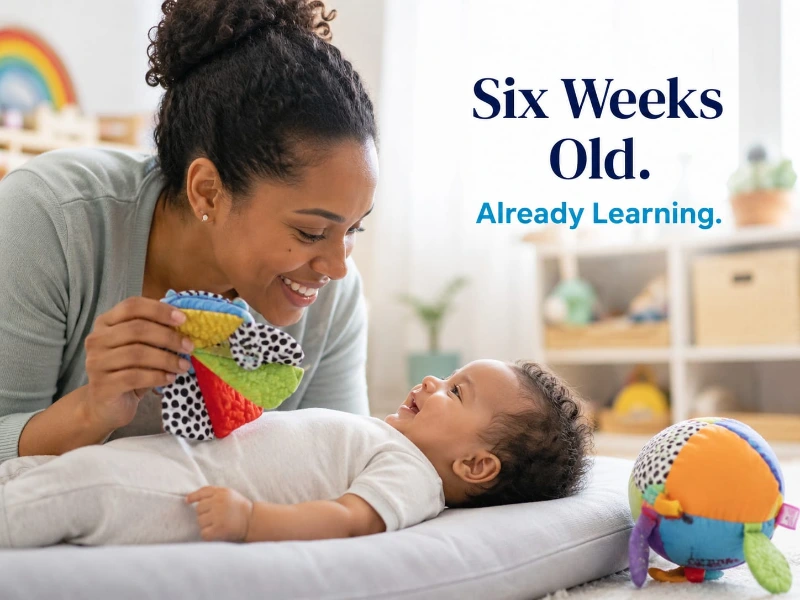
For babies, the Frog Street infant curriculum is less about lessons and more about predictable, loving routines. Feeding, naps, and playtime follow a consistent rhythm, which helps infants feel safe enough to explore.
Sensory play is a big part of this stage. Soft textures, gentle sounds, and simple back-and-forth interactions like peekaboo help build the earliest connections in a baby’s brain, long before words come into the picture. Teachers talk to infants constantly, narrating what they’re doing, which lays the groundwork for language even though a baby can’t respond yet.
Trust is really the goal here. When a baby learns that a caregiver responds consistently, that becomes the foundation everything else gets built on. You can see how this plays out day-to-day in our infant program.
Toddler Program (13–24 Months): Language, Movement, and Independence
Between 13 and 24 months, the Frog Street toddler curriculum shifts focus toward language and independence. Toddlers hear new words all day long, practice small choices like picking a snack, and move their growing bodies through climbing, dancing, and outdoor play.
This is often called the vocabulary explosion stage, and Frog Street builds around it. Teachers narrate everyday moments out loud, name objects during play, and repeat simple songs so toddlers start connecting words to meaning. It’s less about formal lessons and more about talking with purpose.
Independence gets practiced in small, safe ways too. A toddler might scoop their own snack, choose between two activities, or attempt a zipper with a teacher nearby to help. These small wins build confidence long before a child can explain what confidence means.
Movement matters just as much. Toddlers get daily chances to climb, push, pull, and run, which supports physical development and, later, the ability to sit calmly during quieter activities. You can see how this connects to what came before in our toddler classrooms, where the pace stays predictable even as the activities get more active.
Preschool Program (2–3 Years): Early Literacy, Math, and Friendship Skills
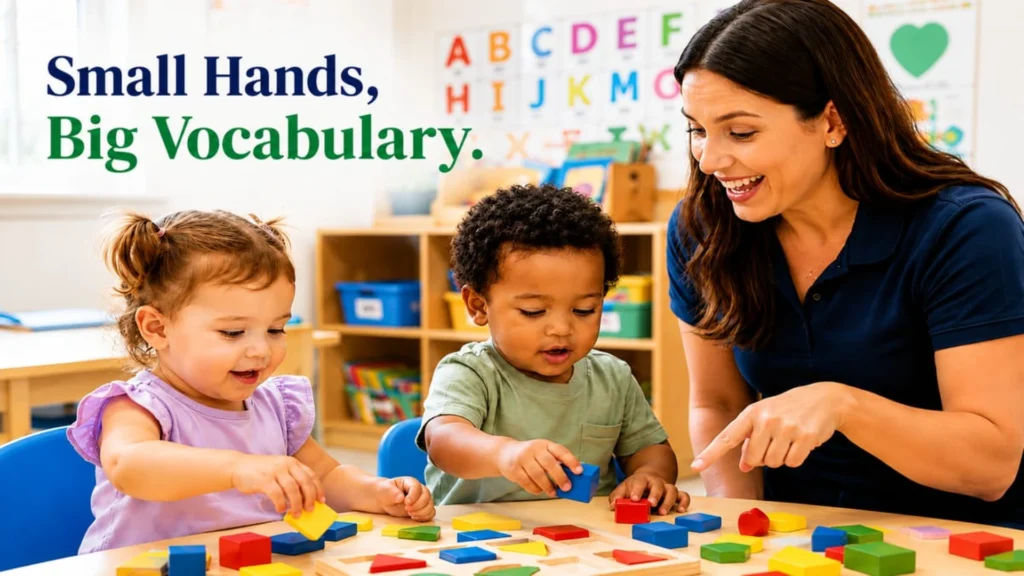
At ages 2 to 3, the Frog Street preschool curriculum introduces the first real building blocks of early literacy and math, alongside a bigger focus on friendship and sharing. This is the first stage where academic-style skills show up, but they’re still taught through play, not worksheets.
Letters and sounds appear through stories, songs, and everyday conversation rather than drills. A teacher might point out the first letter of a child’s name during circle time, or count snack crackers out loud together. These moments plant early number sense and letter recognition without pressure or testing.
Friendship skills get just as much attention. Preschoolers are learning to take turns, wait for a peer to finish speaking, and handle small conflicts like two kids wanting the same toy. Frog Street treats these social moments as real learning, not just something to get through before the next activity.
Hands-on learning activities stay central too, whether that’s sorting shapes, building with blocks, or acting out a story. You can see how these pieces fit together in our preschool program, where literacy, math, and social skills all get practiced side by side.
Pre-K Program (4 Years): Getting Ready for Kindergarten
By age 4, the Frog Street Pre-K curriculum steps up its focus on literacy and math, while still treating social-emotional growth as just as important as academics. Children practice recognizing letters and sounds, counting and simple patterns, and following multi-step directions, all skills a kindergarten classroom will expect.
Structure becomes a bigger part of the day too. Pre-K classrooms follow a more defined schedule than toddler or preschool rooms, which helps children get comfortable with the kind of routine they’ll meet in kindergarten. Group activities, listening to a full story without wandering off, and working somewhat independently all get practiced here.
None of this replaces play. It’s built around it. Explore what a typical week looks like in our Pre-K program.
Will Frog Street Actually Get My Child Ready for Kindergarten?
In most cases, yes, though readiness means more than academics alone. Kindergarten teachers consistently say they care as much about whether a child can follow routines, manage their emotions, and work independently as they do about letter and number recognition.
Frog Street’s Pre-K year builds toward both sides of that equation. The academic pieces, like early reading and math skills, get steady daily practice. So do the behavioral pieces, like sitting through a group activity or handling frustration without a meltdown. A child who’s had a full year of this structure usually walks into kindergarten with both halves in place, not just one.
Frog Street vs. Other Preschool Curriculums: How Do They Compare?
There’s no single “best” curriculum for every child. What matters is understanding what each approach actually prioritizes, so you can judge fit rather than chase a label.
Approach | Best For | What to Expect |
Frog Street | Parents who want a structured, sequenced plan with clear age-by-age goals | Consistent routines, steady literacy and math progression, strong social-emotional focus |
Montessori | Parents who want child-led exploration with less fixed structure | Self-paced learning, mixed-age classrooms, hands-on materials chosen by the child |
No named curriculum | Rare, and worth extra questions on any tour | Learning quality depends entirely on individual teachers, with no consistent framework behind it |
None of these options is automatically wrong for your family. A named, sequenced curriculum like Frog Street simply gives you something concrete to evaluate, instead of relying on a center’s word alone.
How Do You Know a Curriculum Is Actually Being Taught, Not Just Owned?
Owning the materials and actually teaching the curriculum well are two different things, and it’s a fair thing to ask about directly. A few signs are worth checking on any tour, at Fairland or elsewhere.
Ask to see a posted daily or weekly schedule in the classroom. A center genuinely following a curriculum will have one visible, not just a general routine. Ask how new teachers get trained on the curriculum, and how long that training takes. Consistency across classrooms matters too. If you visit two different age groups, both should reflect the same underlying approach, not two unrelated styles.
State quality ratings can help here as well. Fairland is a Texas Rising Star 3-Star Certified center, a rating that requires meeting standards well beyond the state’s basic licensing minimum. That’s an outside check on quality, not just a self-description.
Why Fairland Chose Frog Street
Fairland Learning Academy has served families in the Alief area since 2010, and Frog Street was chosen specifically because it gives every classroom, from infant through Pre-K, a consistent thread of intentional learning instead of a patchwork of unrelated activities.
As a Texas Rising Star 3-Star Certified center, Fairland already meets rigorous state quality standards, and Frog Street reinforces that same commitment to structure inside the classroom itself. Fairland also accepts Texas Education Freedom Accounts (TEFA), making this level of curriculum-backed care more accessible for families across Houston’s southwest side.
See our Texas Rising Star classrooms for yourself. Schedule a tour and ask any question that’s still on your mind.
Ready to See Frog Street in Action?
At the end of the day, a curriculum name on a website doesn’t matter nearly as much as what actually happens in your child’s classroom each morning. What matters is whether that time is intentional, whether it’s building real skills, and whether your child feels safe and known while it happens.
That’s the honest answer behind “What is the Frog Street curriculum?” It’s a framework, not a guarantee, and the center using it is what brings it to life.
Ready to see Frog Street in action? Schedule your free tour and meet the teachers who’ll be with your child every day.