Toddler Milestones From 13 to 24 Months and What to Expect
You just watched another toddler at the park say a full sentence, or take off running across the grass, and yours hasn’t done that yet. That moment sticks with you longer than it should. You start replaying it on the drive home, wondering if you missed something or if your child is simply behind.
Toddler development milestones between 13 and 24 months cover more ground than almost any other stretch of early childhood. A child who was barely cruising along the couch at 13 months might be running, stacking blocks, and stringing two words together by 24 months. The pace looks different in every child, and that difference is the whole point of this guide.
This piece walks through what actually happens during this window, month by month and skill by skill, without pretending every toddler follows the same script. Fairland Learning Academy put this guide together using what actually happens in a toddler classroom every day, not just general theory.
What Counts as Normal Toddler Development Between 13 and 24 Months
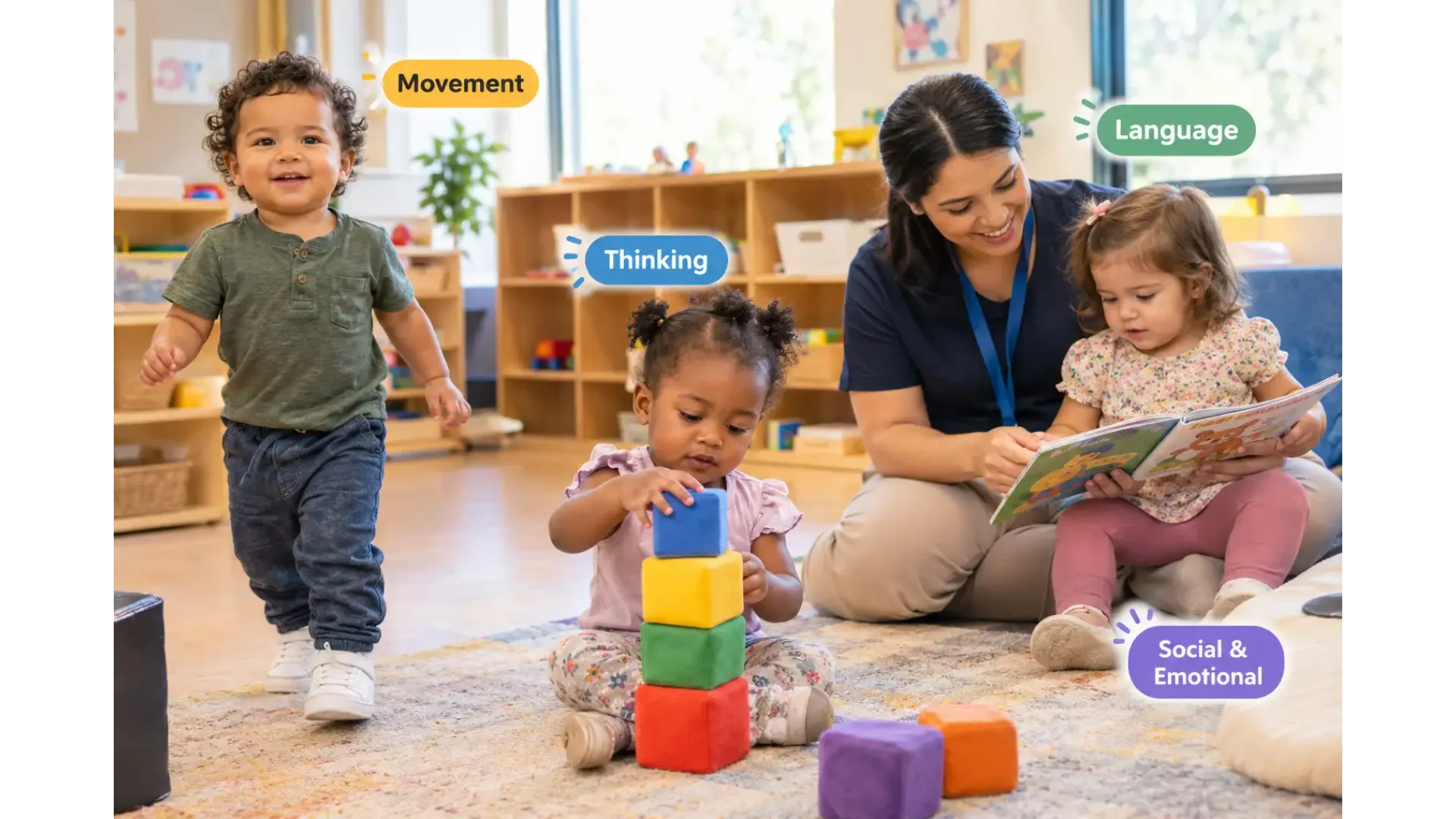
Normal toddler development between 13 and 24 months covers four areas at once: movement, language, thinking skills, and social and emotional growth. Most toddlers go from unsteady first steps to confident walking and running somewhere in this window, and from a handful of single words to short two- and three-word sentences. A wide range of timing counts as typical here.
That range matters more than any single checkpoint. A toddler who walks at 13 months and one who doesn’t walk until 17 months can both be developing exactly as they should. The same goes for talking, where some toddlers have a dozen clear words by 18 months and others are still mostly using sounds and gestures at that point, then catch up quickly a few months later.
Pediatricians look at this stage in ranges, not fixed dates, because that’s how development actually works. The rest of this guide breaks those ranges down by skill area, so you can see where your child fits without measuring them against one rigid timeline.
Movement and Motor Milestones From First Steps to Confident Running
Motor development at this stage splits into two tracks that move at different speeds. Gross motor skills, meaning the big movements like walking and climbing, tend to show up first. Fine motor skills, the smaller hand movements like stacking and scribbling, often take a bit longer to catch up.
Most toddlers spend this entire stretch getting steadier on their feet, then start experimenting with what their body can do once walking feels automatic.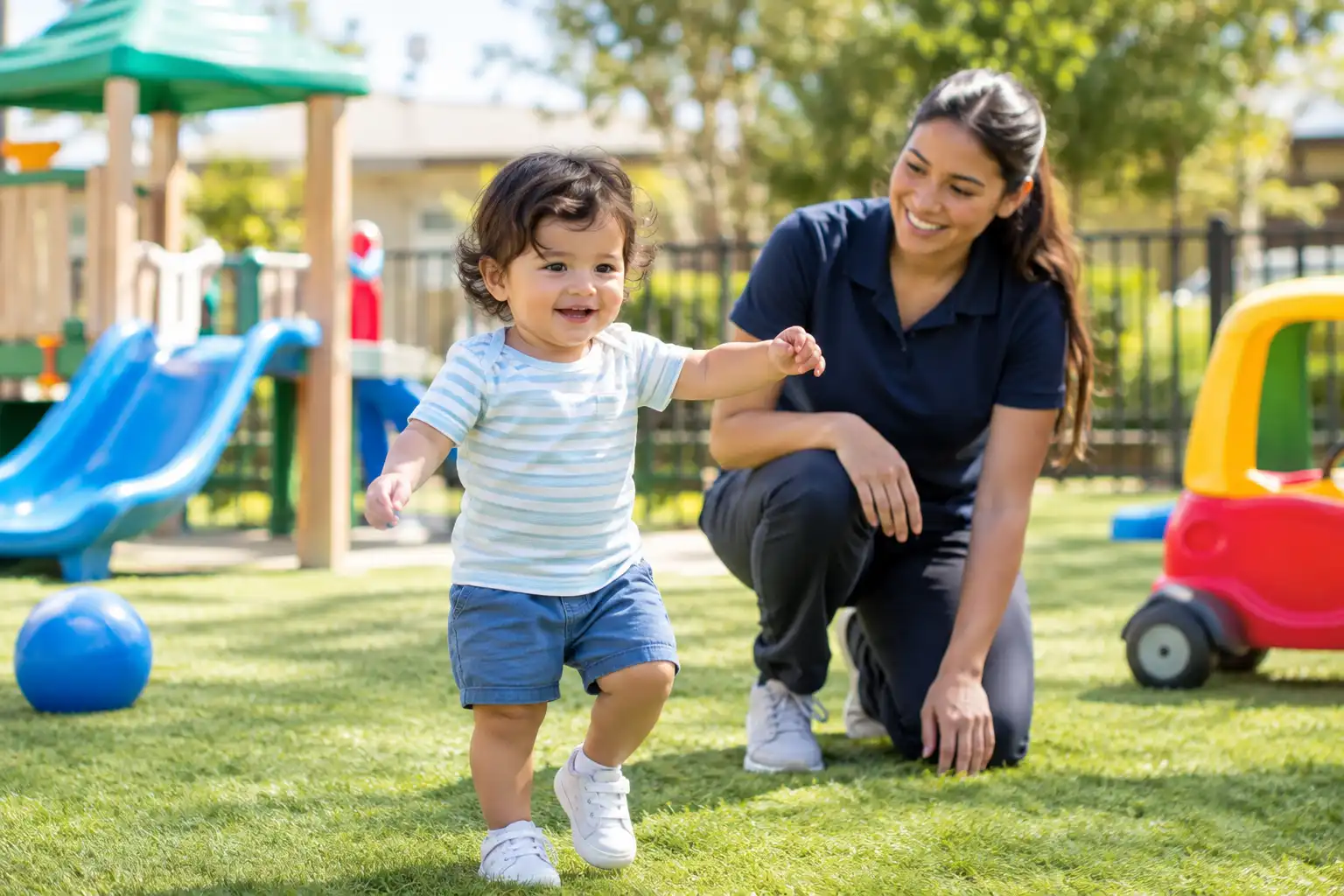
Gross Motor Skills From Walking to Running
Many toddlers take their first independent steps somewhere between 12 and 15 months, though plenty of perfectly healthy kids don’t walk on their own until closer to 17 or 18 months. Once walking clicks, most toddlers move fast toward climbing stairs with help, walking backward, and eventually running by somewhere around 18 to 24 months.
Squatting to pick up a toy and standing back up without falling over is a skill worth watching for too. It shows up quietly, usually somewhere in the middle of this age range, and it’s one of the clearest signs that balance and coordination are coming together.
Fine Motor Skills Like Stacking, Scribbling, and Self-Feeding
Stacking two or three blocks, scribbling with a crayon, and feeding themselves with a spoon all tend to develop across this same window, though rarely at the same pace as walking. A toddler can be an early walker and a later scribbler, or the other way around, and neither pattern says anything about the other.
Self-feeding gets messy before it gets tidy. That’s expected, not a sign of anything off track.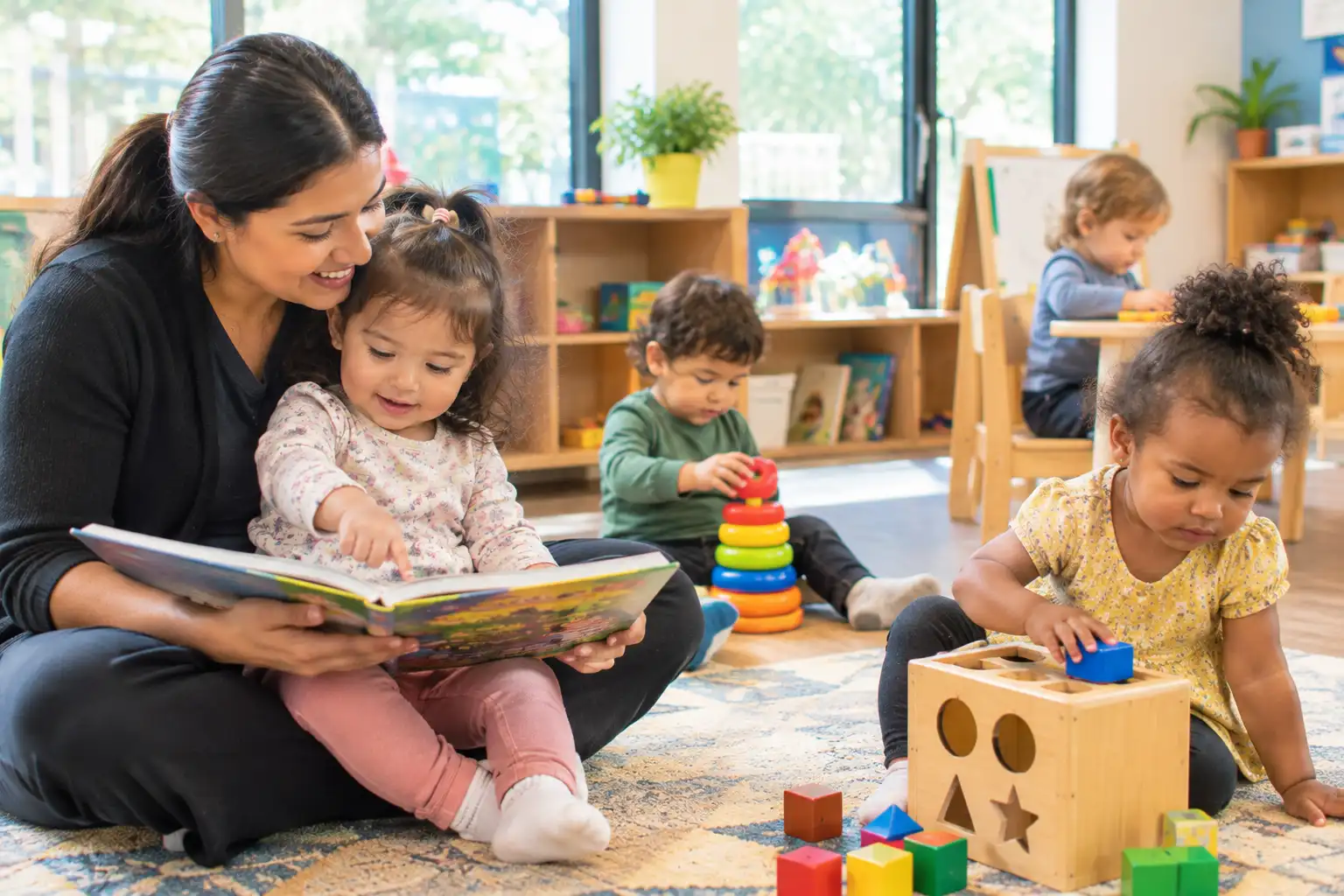
When Do Toddlers Start Talking in Sentences
Most toddlers start combining two words into a simple phrase somewhere between 18 and 24 months, after building up a vocabulary of individual words earlier in this stretch. Short sentences like “more milk” or “daddy go” usually follow a period where the child understands far more language than they can say out loud.
Comprehension almost always runs ahead of speech at this age, which is why a toddler who says very little can still be right on track.
Vocabulary Growth You Can Expect
Word counts vary enormously, and that’s normal, not a red flag. Some toddlers have 10 to 20 clear words by 18 months, while others have closer to 50, and either can be typical. If your toddler isn’t talking much yet at 18 months but clearly understands what you’re saying and communicates through pointing and gestures, that’s often just a slower start on speech specifically, not a sign of a broader problem.
By 24 months, most toddlers have a vocabulary in the range of 50 to 200 words and are starting to combine them.
How Toddlers Communicate Before They Have the Words
Pointing, reaching, pulling you toward something they want, and using sounds with clear intent all count as real communication, even before actual words show up. A toddler who points at the fridge and grunts is telling you something specific.
Watch for that intent to communicate more than the exact form it takes. It usually turns into words on its own timeline.
Social, Emotional, and Thinking Skills at This Stage
Toddlers between 13 and 24 months are learning to assert independence, manage big feelings they don’t yet have words for, and figure out basic cause and effect through play. This is the stage where “no” becomes a favorite word and where a toddler who was easygoing as a baby might suddenly have strong opinions about everything from shoes to snacks. None of that is a personality problem. It’s the actual work of this age.
Independence, Sharing, and Big Emotions
Wanting to do things without help, even when they can’t quite manage it yet, is one of the clearest signs of typical development at this stage. Sharing is a different story. Most toddlers genuinely aren’t ready to share willingly until well past age two, so a toddler who grabs a toy back from another child isn’t behind; they’re simply still their age.
Emotional swings that seem to come out of nowhere are common here too, since toddlers feel things intensely before they can name or explain them.
Early Problem Solving and Play Skills
Sorting shapes, stacking cups in order, and starting to pretend, like feeding a stuffed animal or talking on a toy phone, show up gradually across this range. These small moments of pretend play are actually a sign of real cognitive growth, not just entertainment.A toddler who lines up cars instead of stacking blocks is still building the same kind of thinking skill, just in their own way.
Is It Normal for My Second Toddler to Develop Differently Than My First
Yes, it’s completely normal, and it’s one of the most common things parents worry about without ever mentioning it out loud. Every child has their own pace, even siblings raised in the exact same household with the exact same routines. A second child who walks later or talks earlier than the first isn’t off track; they’re just a different person.
It’s easy to treat your first child’s timeline as the standard, since it’s the only real data point you have. But comparing siblings isn’t like comparing against population averages. Two children from the same family can land on opposite ends of a completely normal range, for reasons that have nothing to do with anything you did differently the second time around.
If your gut says something feels genuinely different, not just slower, that’s worth mentioning at a checkup. But a difference in pace on its own usually isn’t a signal of anything beyond two kids being two different people.
When to Simply Watch, When to Mention It, and When to Call
There’s a real difference between a skill that’s just slower to show up and one that needs a closer look, and most guides skip straight past this part. As a general way to think about it, a skill that’s a little behind average is usually still within typical range. A skill that hasn’t started at all by the upper end of its window is worth bringing up at the next visit. A skill your toddler is actively losing, not just delaying, is worth a call sooner.
That middle category is where most of the anxiety lives, and it’s also the one where waiting for the next scheduled checkup is usually the right move, not a sign of ignoring the problem.
What It Means If Your Toddler Pauses or Loses a Skill
A toddler who briefly stops doing something they’d already started, like a few words that seem to disappear for a couple of weeks, isn’t necessarily regressing in a concerning way. Illness, teething, or simply focusing hard on a different skill can cause a temporary pause in another area.
A skill that fully disappears and doesn’t come back after several weeks is a different situation, and that’s the one worth calling about rather than waiting to see.
Does Daycare Help or Hurt Toddler Development
Time spent in a well-run toddler daycare program is not lost development time. A structured classroom builds the same skills a parent works on at home, often through more repetition and more consistent daily practice than one household can offer alone. The hours your toddler spends away from you can be some of the most productive hours of their day.
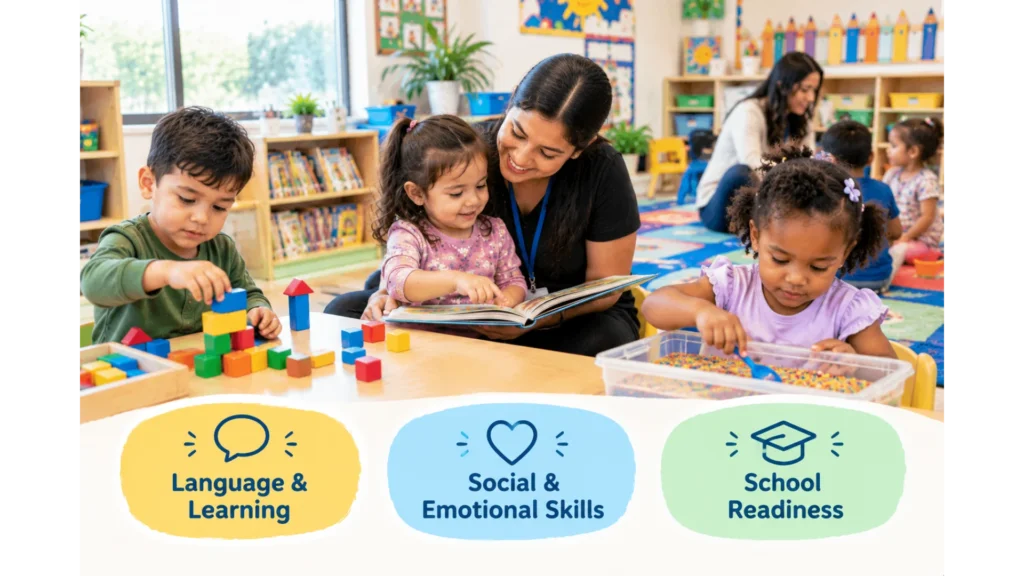
At Fairland Learning Academy‘s toddler daycare program, the day is built around exactly the skills covered above. Group storytime and narrated play build vocabulary the same way bedtime books do at home. Supervised outdoor time and guided play build the same gross motor skills as a trip to the park. Structured mealtimes give toddlers daily, repeated practice at self-feeding in a setting built for exactly that.
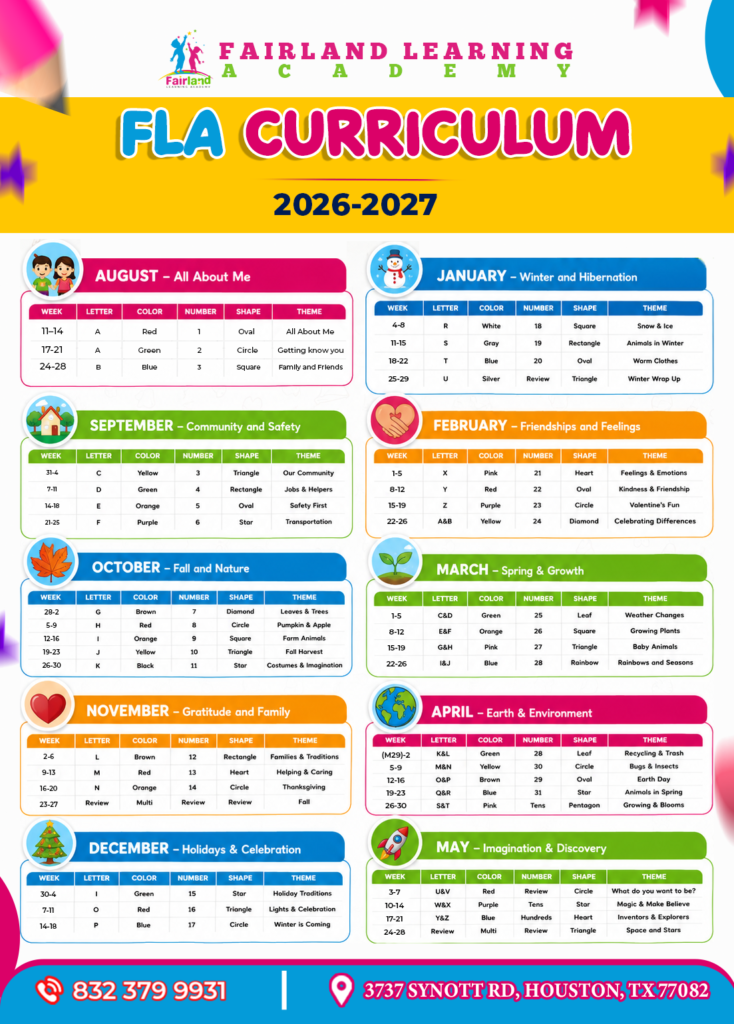
The classroom follows the Frog Street Curriculum, which was built specifically around these early developmental stages rather than adapted from an older age group. That distinction matters more than it sounds like it should, since a curriculum designed for 3- and 4-year-olds doesn’t actually fit what a 15-month-old needs from their day.
What a Strong Toddler Daycare Curriculum Looks Like
A strong toddler curriculum touches every skill area covered in this guide, not just one or two. If you’re comparing programs, it helps to know specifically what to look for rather than taking a brochure’s word for it.
For language, look for daily storytime, group conversation, and staff who narrate what they’re doing throughout the day, since toddlers build vocabulary by hearing language attached to real moments. For movement, look for regular outdoor time and supervised active play, not just time spent seated. For social and emotional growth, look for group activities that give toddlers repeated, low-pressure practice being around other kids their age. For independence, look for support with self-feeding and, as toddlers get closer to two, early potty training encouragement rather than a program that treats every child the same regardless of age.
A center that is Texas Rising Star 3-Star Certified, like Fairland, has already been evaluated against state quality standards covering staff training, curriculum, and classroom practices, which takes some of the guesswork out of that comparison. Programs supporting toddler development at this stage should be able to explain exactly how their daily schedule maps to skills like these, not just describe the day in general terms.
Simple Ways to Support Development at Home Every Day
You don’t need special toys or a structured lesson plan to support your toddler’s development at home. The ordinary parts of your day already do most of the work, as long as you’re narrating and engaging through them rather than rushing through on autopilot.
Talk through what you’re doing during meals and diaper changes, even when it feels one-sided. Narrating “we’re washing your hands now, the water is warm” builds vocabulary the same way a structured lesson would. Reading the same book over and over, as repetitive as it feels to you, is exactly how toddlers absorb new words and sentence patterns.
Let mealtime be messy sometimes, since self-feeding practice only happens when you allow the mess that comes with it. And outdoor time, even just walking around the yard or a short walk around the block, gives your toddler the same kind of gross motor practice a structured activity would offer, without needing to plan anything at all.
Talking to Grandparents and Other Caregivers About What You’re Seeing
If a grandparent or regular caregiver notices something and isn’t sure how to bring it up, the safest approach is to share an observation, not a diagnosis. Saying “I noticed she’s not saying many words yet; is that something worth mentioning at her next checkup?” lands very differently than “I think something is wrong with her.”
Caregivers who see a toddler less often sometimes catch changes parents miss simply because they’re not there every single day. That’s useful information, not something to sit on out of fear of overstepping. Framing it as a question rather than a conclusion usually keeps the conversation open instead of putting a parent on the defensive.
Give Your Toddler a Strong Foundation Starting Today
That moment at the park, watching another toddler do something yours hasn’t done yet, doesn’t have to mean what it felt like it meant. Most of what separates one toddler from another at this age is timing, not ability, and the range of normal here is wider than it looks from the sidelines.
Every stage from infancy through toddlerhood builds on the one before it, and having the right daily environment during this window makes a real difference. If you’re weighing options for your own toddler, or you have a younger child still in Fairland’s infant daycare program and wondering what’s next, contact our team to schedule a visit, or call us at 832-379-9931 to talk through your child’s stage today.