You’ve probably heard some version of the same line from three different people: preschool matters, get your kid into a program early, the first few years shape everything. Nobody explains what that actually means for your specific child, and nobody tells you whether the $600-a-month tuition is buying real development or just a supervised room to wait out the workday in. That’s the actual question underneath “why does early childhood education matter,” and it deserves a real answer instead of a poster on a wall.
This isn’t a pitch for why school is good. It’s a breakdown of what structured early learning does inside a child’s brain and behavior between birth and kindergarten, why the benefits look completely different for a one-year-old than for a four-year-old, and how you tell a program that’s actually delivering those benefits from one that’s just running a clean, friendly daycare with a curriculum poster taped to the wall.
Is Early Childhood Education Really Worth It, or Is It Just Expensive Babysitting?
Say this part out loud, because most parents think it and never ask it. If your toddler spends the day finger-painting, napping, and eating goldfish crackers, how is that different from a well-run home daycare charging half the price?
The honest answer: sometimes it isn’t. A center that fills the day with unstructured group time and calls it early childhood education is charging a premium for a label, not a curriculum. The difference that actually matters is whether the day has intentional structure behind it, meaning specific skills get targeted at specific developmental windows, teachers track where each child is against age-typical milestones, and the “play” is designed rather than just tolerated.
Play-based learning is a real pedagogical approach, not a euphemism for free time. A teacher running play-based learning has picked the materials, set up the activity, and is watching for specific things: does this child use two-word phrases yet, can they hold a crayon with a developing grip, do they attempt to solve a small conflict with a peer before asking an adult to fix it. That’s the difference between a program worth the tuition and a room worth the hourly rate. The rest of this article is about how to tell which one you’re looking at.
What Early Childhood Education Actually Builds in a Child’s Brain and Behavior
Early researchers on brain development kept landing on the same finding: a huge share of a child’s brain architecture forms in the first five years, well before kindergarten even starts. The exact percentage cited varies by study and by which part of brain development gets measured, so treat any single number you see with some skepticism, but the underlying point holds up across the research: the early years are not a waiting room before the “real” learning starts in elementary school. They’re when the wiring for later learning actually gets laid down.
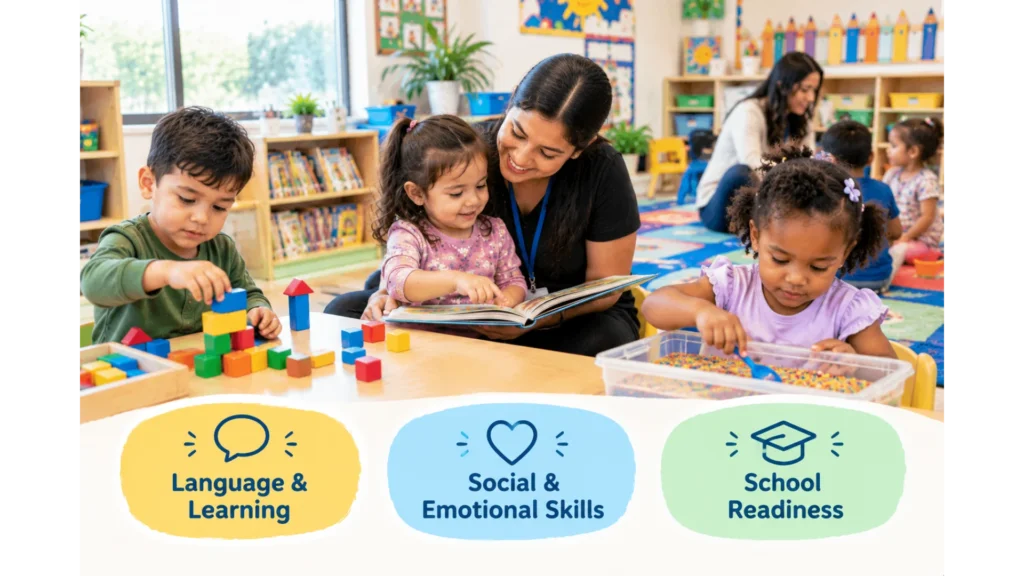
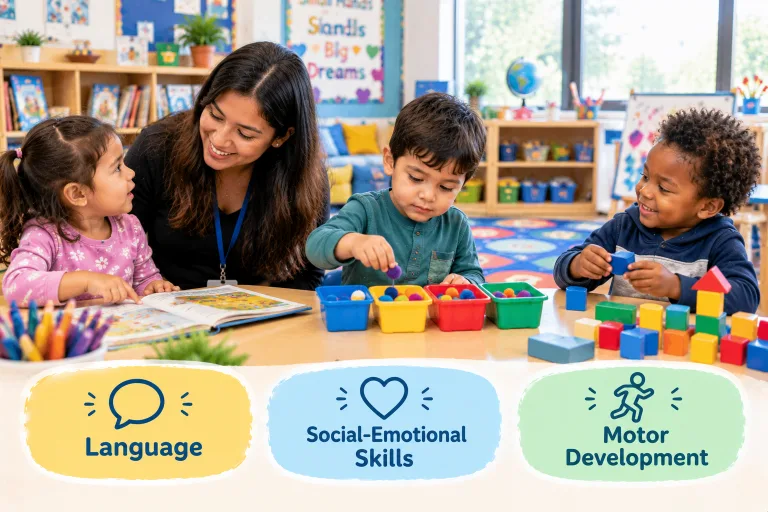
That shows up in three concrete areas, and a good program is deliberately building all three at once.
Cognitive and Language Development
A two-year-old in a language-rich, structured environment hears more varied vocabulary in a single morning than the same child would pick up passively at home over several days. Teachers narrate what they’re doing, ask open questions instead of yes-or-no ones, and introduce new words attached to real objects and actions rather than flashcards. Early literacy exposure at this stage isn’t about reading books early. It’s about a child learning that print carries meaning, that stories have a beginning and an end, and that numbers describe real quantities they can count on their fingers.
Social-Emotional Development and Self-Regulation
Watch a well-run toddler classroom for ten minutes and you’ll see the actual skill-building happen in tiny moments: a teacher naming a child’s frustration out loud (“you’re upset because Marcus took the truck”) before helping them find words for it themselves. That’s self-regulation getting built one small conflict at a time, and it’s a skill that predicts how a child handles disappointment years later, not just how they behave at age three. Sharing, waiting for a turn, and managing a meltdown without hitting are learned skills, not personality traits a child either has or doesn’t.
Physical and Motor Development
The fine motor work matters more than it looks like it should. A four-year-old who’s spent two years stringing beads, using child-safe scissors, and stacking blocks has the hand strength and coordination to hold a pencil correctly on day one of kindergarten. A child who hasn’t done that work spends the first months of kindergarten catching up on grip and control instead of learning letters, which puts them a step behind before the academic content even starts.
Why the Benefits Look Different for an Infant Than for a Preschooler
Here’s where a lot of general advice about “early childhood education” falls apart. Articles written for a generic audience treat birth through age five as one long stretch where the same benefits apply evenly. They don’t. What a ten-month-old needs from a program and what a four-year-old needs from a program are almost entirely different things, and a good center is built around that difference on purpose, not by accident.
Infants and Toddlers: Attachment, Safety, and Early Brain Wiring
For a baby or a young toddler, the single biggest developmental need isn’t stimulation. It’s consistency. A child this age is building their first sense of whether the world is safe and predictable, and that sense gets built through the same caregiver responding to their cries, feeding them on a rhythm they can count on, and being there again tomorrow. A program with high staff turnover undermines this specific benefit no matter how good the toys are, because the child never gets to finish building trust with one adult before that adult leaves.
This is also the window where sensory-rich, hands-on exploration does the most work. Textured materials, safe objects to mouth and grab, tummy time, and simple cause-and-effect toys (push this, that happens) are doing real wiring work, not just passing the time until nap.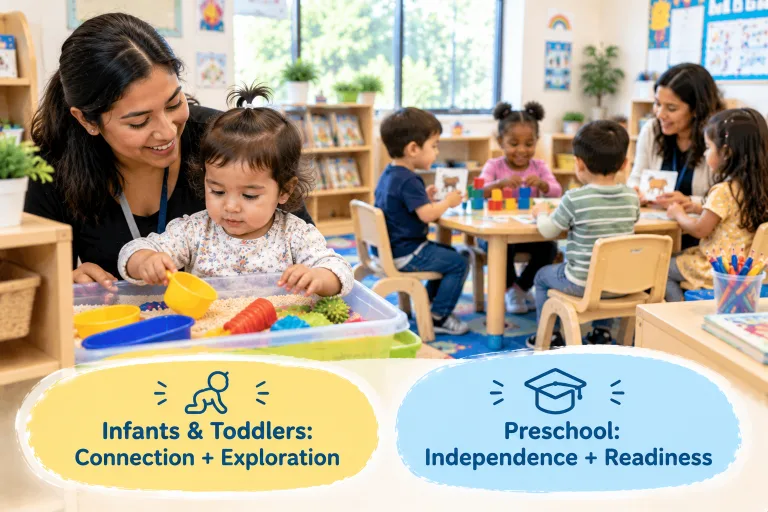
Preschool and Pre-K: School Readiness and Independence
By age three or four, the job changes. Now the benefit that matters most is building the specific skills a kindergarten teacher will assume your child already has: sitting through a group activity for ten or fifteen minutes, following a two-step instruction without needing it repeated, using the bathroom independently, and separating from a parent without a meltdown that eats up the first twenty minutes of the school day.
School readiness doesn’t mean knowing the alphabet, although that helps. It mean being ready for the structure of a classroom, and that’s a completely different skill set than what an infant program is building. A three-year-old who’s spent a year practicing circle time, cleanup routines, and taking turns walks into kindergarten with a real head start that has nothing to do with letters or numbers.
What the Research Says About Later Academic and Social Outcomes
The research on long-term outcomes is genuinely strong, though it’s worth being precise about what it actually shows rather than repeating the boldest headline version of it. Multiple longitudinal studies tracking children from quality early education programs into their K-12 years have found better outcomes on measures like reading and math scores, high school graduation rates, and reduced need for special education services, compared to children who didn’t have access to similar programs. The effect sizes vary by study and by how “quality” gets defined, so any specific number you see quoted should be treated as one data point in a broader pattern rather than a guarantee for any individual child.
What holds up consistently across the research is the direction of the effect, not a precise percentage. Kids who spend meaningful time in structured, language-rich, socially engaging environments before kindergarten tend to arrive at school with a real advantage, and that advantage doesn’t fully disappear even years later. It shows up less as “smarter” and more as “better equipped to handle the demands of a classroom,” which tracks with everything in the sections above about self-regulation and school readiness being learned skills.
Quality Early Childhood Education Supports Working Parents
Most of what gets written about early childhood education treats the parent as a bystander to the child’s development. That misses half the actual value. A program that reliably opens on time, handles minor illness and injury with real judgment instead of panic, and communicates clearly about a child’s day gives a working parent something that’s easy to undervalue until you don’t have it: the ability to focus at work without a background hum of worry.
That matters more than it sounds. A parent who trusts their child’s program can take a call, finish a shift, or sit through a meeting without mentally rehearsing worst-case scenarios. A parent who doesn’t trust it is distracted at work in ways that are hard to measure but real, and that stress tends to travel home at the end of the day too. Quality early childhood education isn’t just an investment in the child sitting in the classroom. It’s infrastructure that lets the whole household function.
How to Tell If a Program Delivers These Benefits
Every childcare website says some version of “we support your child’s development.” That phrase is free. What separates a program that actually builds the benefits covered above from one that’s just using the right words comes down to three things you can check yourself, in person, before you sign anything.
Look for a Real, Age-Appropriate Curriculum
Ask what the toddler room and the pre-K room are each working on this month, specifically. A program with a real curriculum can tell you: the toddler room is focused on two-word phrases and simple sorting, the pre-K room is working on letter sounds and following three-step instructions. A program that answers with “we do a lot of hands-on activities” and stops there probably doesn’t have a structured plan behind the day, even if the classroom looks busy and cheerful.
Check Licensing, Ratings, and Staff Qualifications
Texas draws a real distinction between a center that’s simply licensed and one that’s earned a Texas Rising Star certification, which requires meeting higher standards for curriculum, staff training, and ratios than baseline licensing alone. Ask directly whether the center is HHSC-licensed and whether it holds a Rising Star rating, and ask what star level. Both are things you can verify independently rather than taking the center’s word for it, which matters if you’re the kind of parent who’s been burned by a confident answer before.
Ask About Ratios and Consistency of Care
A lower staff-to-child ratio means more actual attention per child, and it’s one of the clearest predictors of whether the social-emotional benefits covered earlier actually happen in practice. Ask about staff turnover too. A program that’s replaced most of its infant room staff in the last year is going to struggle to deliver the consistency that age group depends on most, no matter how strong the stated curriculum is on paper.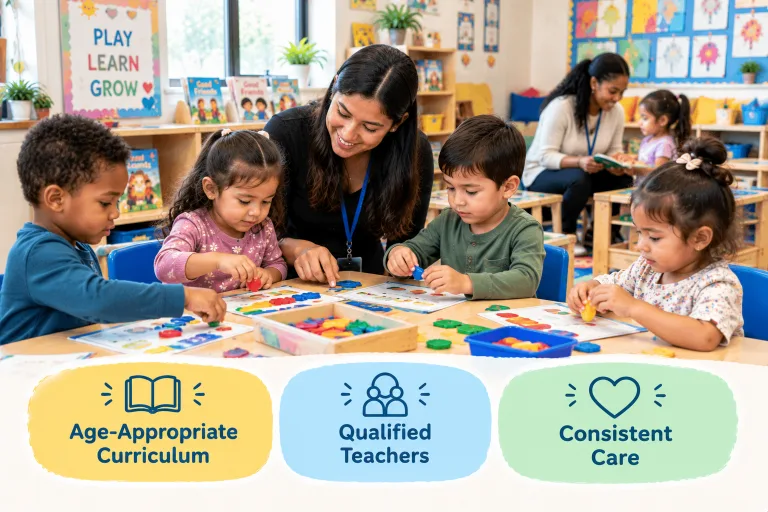
Early Childhood Education, Right Here in Alief and Sugar Land
Everything above is true regardless of where you live, but the actual decision you’re facing is local. Fairland Learning Academy, located at 3737 Synott Rd. in Alief, serves infants through school-age children with a curriculum built around the age-banded approach described earlier in this piece: attachment-focused care for infants and toddlers, school-readiness structure for preschool and pre-K.
You don’t have to take that on faith either. The center is HHSC-licensed and holds a Texas Rising Star rating, and families who qualify can use a Texas Education Freedom Account (TEFA) toward tuition, which is worth asking about directly if cost has been part of what’s held you back from a program like this.
It’s also worth noting that even Alief ISD has been investing directly in expanded pre-K capacity in the district, a sign that the value of structured early learning isn’t a marketing claim invented by private centers. The public school system is racing to build more of it too, largely for children already at preschool age. For infants and toddlers, that district-level option doesn’t exist yet, which is the gap a program like Fairland is built to fill.